Category Archives: Policy discussion

Evidence of Decoupling Still Zero.

The Growing Effort to Decouple GDP from Energy use and CO2,
is having no apparent effect,
raising serious questions about the nature of our plan.

The graph below (Figure 1) shows the 46-year record of world GDP PPP, Energy, and CO2, during which their growth rates have been in constant proportion to each other, called their “coupling.” The things to read are 1) the lack of accumulative departure from the steady trends, and 2) how closely the exponential trend lines (dotted) follow the data.

It shows that the long trend still holds despite both big efforts and bigger promises that accelerating growth using more efficient processes would separate the expanding economy from its impacts.  Focusing so much on the “positive” completely disguised the big picture, though, that in 46 years there has been no accumulative effect at all.  So there’s a lot to explain, yes, but the graphs below show persistent regular behaviors of the economy as a whole resilient system, a problem not yet faced at all.
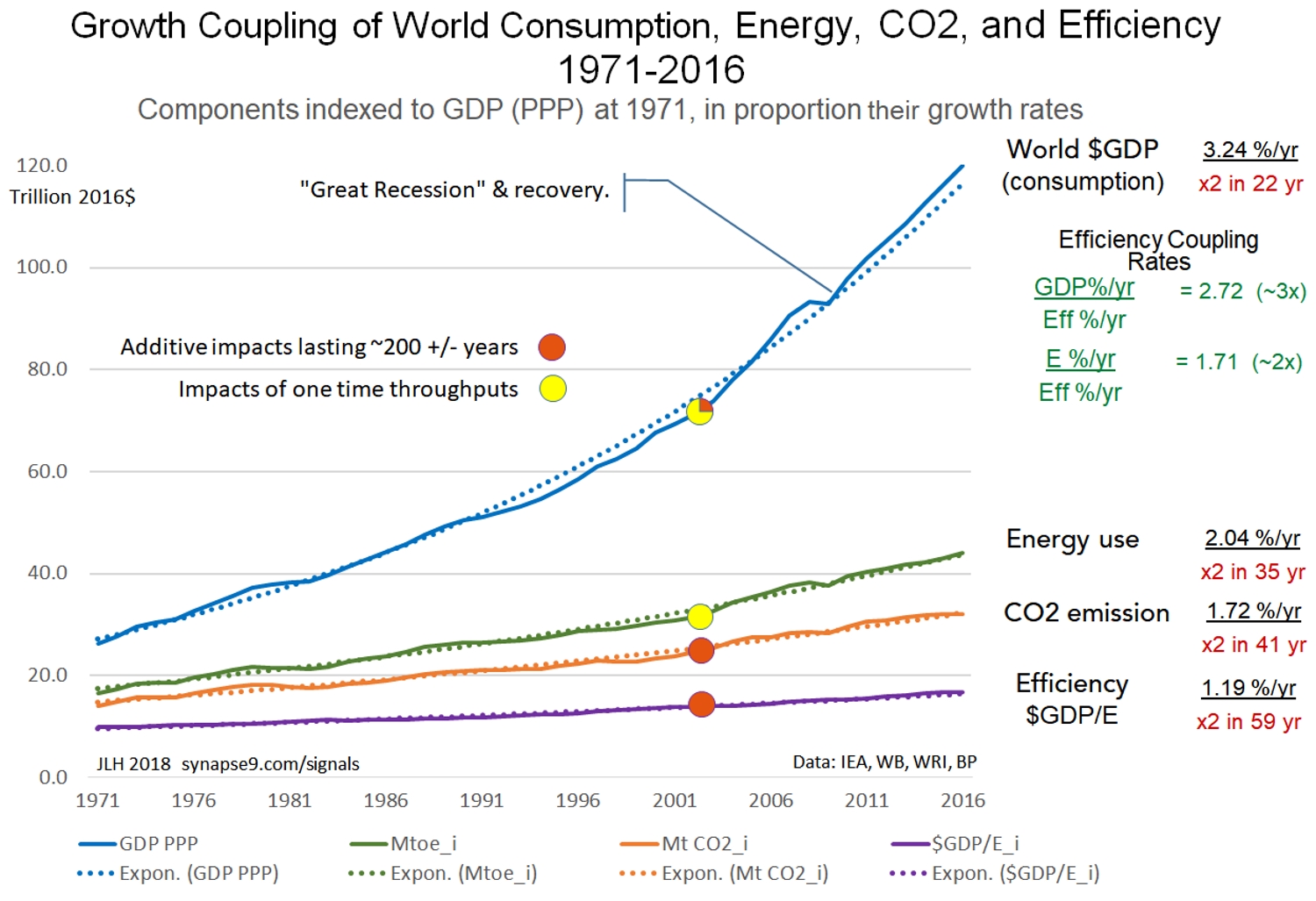
Figure 1. Coupled Growth Trends of World GDP, Energy & CO2, showing how the three move together at proportional growth rates, as parts of a whole system.

That energy use and CO2 emissions are now still growing at the same rate as 40 years ago is strong evidence that none of the sustainability measures such as exceptional efficiency gains said to decouple the economy from its impacts, have had any effect at all.

The irregularly fluctuating curves below (Figure 2) show the annual rates of coupling if world Energy and CO2 growth rates to World GDP (PPP).  The scale at the left shows their locally averaged growth rates as a fraction of the locally averaged GDP growth rates (to somewhat smooth the curves) going below zero once.  The important thing is to notice is that the fluctuations vary around nearly horizontal trendlines.

It’s as if the economy is guided by an “invisible hand” keeping the fluctuations symmetric to the near constant trend.  It says the fluctuations have been adding up to no effect.  The likely cause of this is how a competitive economy naturally works.  Technology and resources are supposed to be treated as being fungible assets, to be constantly reallocated to maximize profits.  In the data, that functional coupling between the physical and financial systems of the economy is shown working rather smoothly, replacing less with more profitable assets to maximize the growth of profits for the whole.  That stable coupling of managed assets to growth is then an apparent natural emergent property of the system as a whole, as a partnership between human cultures and the financial world’s effort to maximize growing profits.
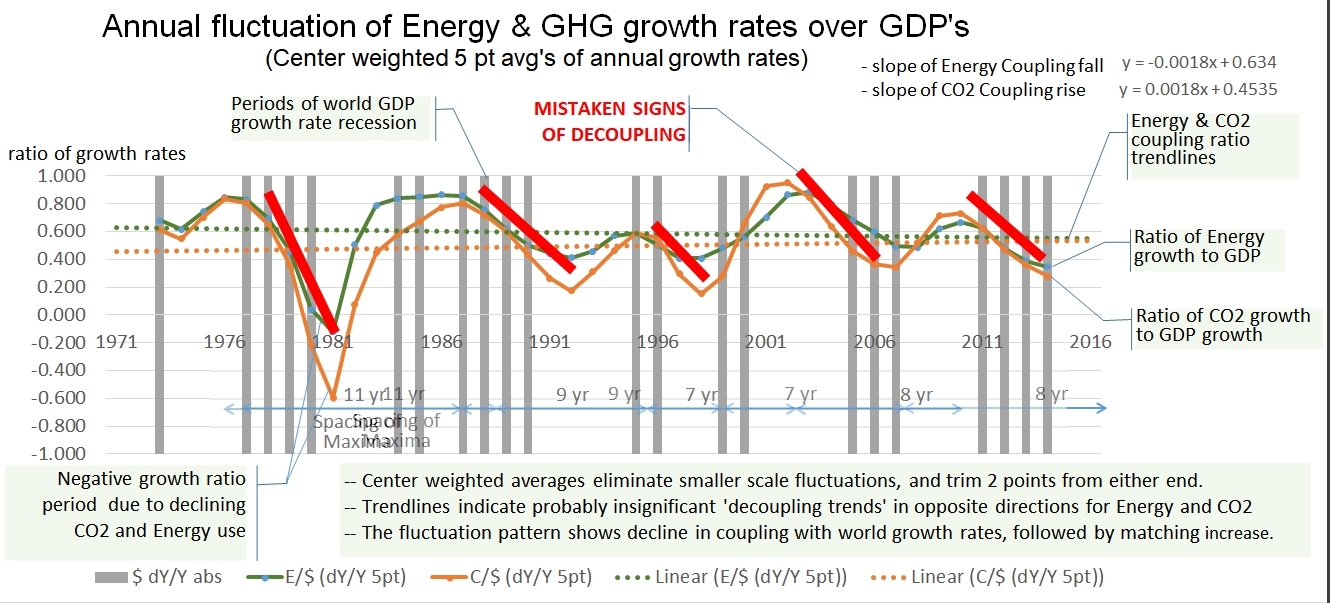
Figure 2. Regular fluctuations of Energy and CO2 coupling with GDP, have repeatedly been claimed to be evidence of rapid decoupling… ignoring how very regularly the periods of apparent decline were followed promptly by reversals, as if irregular waves of water seeking the average level. 

 How the world community came to say that “sustainable development” would reverse this stable natural relationship between the economy and its resource uses is described in more detail in April 2014 in The Decoupling Puzzle. Small fluctuations do keep causing excitement for both devoted climate deniers and sustainability advocates, though, each picking out brief trends seeming to affirm their hopes, like the five periods of apparent rapid decline in CO2 to GDP coupling shown here.  The real evidence is that the local fluctuations never seem to result in a change in the direction of the whole, like ripples on a pond that always level out.  The latest dip in the CO2 coupling trend has been claimed as a sign of turning the corner by the IEA, clearly unaware of the consistent pattern of that metric repeatedly fluctuating around a near-zero trend.

Added perspective on the global data is gained by plotting the ratio of GDP to Economic Energy energy, the amount of wealth produced with a unit of energy.  We call that variable “Economic Energy Efficiency,” the amount of economic wealth generated per unit of energy.  Having its growth rate = 1/3 the GDP rate implying that improving efficiency contributes 1/3 of the value of energy to the world economy, growing Energy use contributing 2/3 if the value.  That ratio demonstrates a general case of Jevons famous observation that in a growth economy efficiency results in growing rather than declining resource use and impacts.  Any way one reasons it, what is crystal clear is that in the last 46 years strenuous effort to use efficiency for sustainability have had the opposite of the intended effect, recreating the original problem rather than solving it.

Figure 3 The share of GDP growth contributed by Economic Energy Efficiency proves Jevons principle that in a growth economy efficiency multiplies energy use and all its accumulative earth impacts.


So we need to be suspicious of the world policy to maximize growth at any cost.  The costs are rapidly swelling not shrinking.  The other coupled impacts of growth also causing how people live being forced to change ever faster creating major disruptions and dissension all over the world is one of the biggest, though even the NGOs are very slow in recognizing.  In nature, growth is how all kinds of natural systems begin, but those we admire for their perfection turn to refining their designs before they climax rather than, driving their growth to the point of being torn apart of being exhausted.

That’s the trick.  Maximizing growth might seem logical as a way for societies to keep up with social distress and debts, but now it’s accelerating them.  So now we need to balance the attraction of short-term profits and connect them all the unbalanced disruptive changes that now surround us.  We talk lightly about replacing people with robots, for example, overlooking that the robots only work for the banks.  That’ll make people and governments ever more indebted and incapable of responding to climate change, for one problem.  And that chain of consequences goes on and on, that is as long as we keep ignoring how natural growth systems that avoid the problem work.  More disruption is not the solution, only moderation.

There’s an alternative business model that could serve as a general design for growth without disruption, one that switches to paying the profits forward once any debts have been paid back.  Once understood, that is what would achieve truly integrated, thriving and self-limiting development, as biomimicry of ecosystem designs.  It is discussed in more detail in the article linked from my next post, Culture, Finance-for-Development, and tPPPs.

Use biomimicry for how nature uses growth to build thriving and enduring systems.

It would be a way for businesses large or small to begin to experiment with how nature succeeds in creating beautiful, thriving, and purposeful systems.  It’s a fairly simple formula.  It’s also a practice we all know well for how to successfully relate to other people and how to successfully complete business or home projects.  It starts with building up innovations to then select what to refine for making the result resilient and purposeful in its environment.  If we approached every new relation or project by piling on new experiments with no turn toward refining something to last in the end, all the effort would go to waste in the end.

To start you study the similarity between nature’s way of building things to perfection and how we do our own home or office projects! They all take place in “three acts.” The first act is for “innovating, the second for “refining, and the third act the “release” of the finished product into its waiting environment (IRR).  You see the same three acts in the birth cycle, and in the start-up of new businesses too, as well as the formation of new cultures and most every other kind of individual development.  The trick is really to pay attention to the inspiration that starts it off, as something to fulfill.  That lets you anticipate and move smoothly between the stages of emerging development, first adding up more innovations, then refining the ones worth keeping to the end.  It’s what comes most naturally when we can see the whole effect.

_________________

When you can see the whole it’s easy to recognize the point when adding more innovations begins to work against getting something finished, called a “point of diminishing marginal returns.” Of course on a home or office project what tells you it’s time to shift to finishing what you started is just sensing what can you finish while you have time and resources.  For anything measurable, like wealth, the point of diminishing marginal returns is when it becomes more profitable to put efforts into getting things to market rather than try more experiments.  To apply it to the world all you do is ask: “What is our real plan here?” and look around for how to perfect what we started, and at the right time stop taking on more and more that we probably won’t be able to finish.  It’s a matter of shifting to pursuing achievable goals rather than hanging on to thinking ever bigger with no end in sight.  Reaching for the right goal doesn’t necessarily make the work easy, of course, particularly for big personal, community or business projects.  It just makes the work a lot better, and the end something fulfilling and rewarding.

I discuss that as a way to measure truly lasting success for the UN’s 2030 Agenda and its Sustainable Development Goals, instead of just “more, faster” the ways the UN’s goals are like the goals of business-as-usual, discussed in more detail in Culture, Finance-for-Development and PPPs.

JLH


Analysis Notes:

  • The global GDP PPP curves show IEA data from 1971 to 2008 spliced to overlapping World Bank Data from 1990 to 2016.  The curves for global Energy are from BP statistics, and the Global CO2 curves show data from WRI.
  • The Energy and CO2 curves were each scaled to the GDP curves in proportion to their average growth rates for a graphically clear and honest comparison.
  • dy/Y is the ratio of the change in a measure over the total, like an interest rate or growth rate measures.  I get smoother curves by blending a bit, using a center-weighted 5 point bracket.

Data Sources:

  1. The world bank was my source for GDP PPP and for from 1990 to 2016
    https://data.worldbank.org/indicator/NY.GDP.MKTP.PP.CD?end=2016&start=1990
  2. World Meat Production – 1961-2016 Rosner – OurWorldInData: https://ourworldindata.org/meat-and-seafood-production-consumption
  3. World Food Production – 1961-2016 FAO: http://www.fao.org/faostat/en/#data/QI
  4. WRI has a very nice set of data on CO2 “Total GHG Emissions Including Land-Use Change and Forestry – 1990-2014” from the CAIT Climate Data Explorer – http://cait.wri.org/historical.
    – Because the latest economic CO2 emissions data is 2014 not 2016 as for other data, the trend of atmospheric CO2 from CO2.earth was used to project the economic emissions data for the last two missing data points, showing no anomalous direction. https://www.co2.earth/annual-co2
  5. Atmospheric CO2 PPM 1501-2015                    
    OurWorldInData.org:
    https://ourworldindata.org/co2-and-other-greenhouse-gas-emissions
    From Scripps source directly: (Scripps, 1958 to present)(Macfarling Meur 2006)
     http://scrippsco2.ucsd.edu/data/atmospheric_co2/icecore_merged_products
    Record based on ice core data before 1958, and yearly averages of direct observations from Mauna Loa and the South Pole after and including 1958.”
  6. BP offered energy data in MtOe in its “Statistical Review of World Energy – all data 1965-2017”
    https://www.bp.com/en/global/corporate/energy-economics/statistical-review-of-world-energy/downloads.html
  7. The IEA news item statement that CO2 flattened for 2016 and 2017 was used, just to show how little effect it would have if true
    https://www.iea.org/newsroom/energysnapshots/global-carbon-dioxide-emissions-1980-2016.html

the Fiduciary Duty for Business Speech – to Not Be Misleading

We Need Business to Honor Its Fiduciary Duties

Just Talking and Writing About it Would Put it on the Agenda!

A fiduciary represents the interests of others in a way that is NOT MISLEADING.

– Wikipedia/fiduciary

“In such a relation good conscience requires one to act at all times for the sole benefit and interests of another, with loyalty to those interests.“

“A fiduciary is someone who has undertaken to act for and on behalf of another in a particular matter in circumstances which give rise to a relationship of trust and confidence.[1]”

fiduciary duty[2] is the highest standard of care at either equity or law.”

– The wide implications relations based on fiduciary trust – JLH

  1. Professionals making decisions for others have a duty to act in the client’s best interests, to the best of the fiduciary’s ability, as the basis of trusting the fiduciary’s services.
  2. The law doesn’t limit “best interests” of others to short term financial gain, leaving open all other interests everyone has a right to, such as not being misled, living sustainably, respecting due process and receiving justice.
  3. What has changed in the modern world is that we face more threats and know more about them, so now we can hold our professionals responsible, demanding our universal human interests be respected as their fiduciary duty.
  4. Putting this on the human rights agenda would only take talking and writing about it.

– Current Law: The Fiduciary Duty for investors[i]

“Whenever you are dealing with someone to whom you will entrust your money, such as a registered investment adviser or a bank trust department, it is nice to know that, in the United States, they owe you what is known as a fiduciary duty.  This is not to be taken lightly because, under the American legal system, a fiduciary duty is the highest duty owed to another person.  It requires the fiduciary (the person with the obligation) to put the interest of the principal (the person to whom they owe the fiduciary duty) above their own.”

“This requirement to act in their best interest includes disclosing any conflicts of interest that may arise so they can be known ahead of time, leveling the playing field.  Breaching the fiduciary duty can result in draconian punishments, including being barred from employment in certain fields, being banned from working with certain types of securities, being forced to pay significant civil and criminal penalties, the loss of employment, and, in some cases, felony conviction with accompanying jail time.  To put it bluntly, the fiduciary duty has teeth.”      [see source for rest of article]

– What is “Fiduciary Duty”,… “Business Duty”[ii]

“A “fiduciary duty” is required of a person who manages money, investments, or other property on behalf of another person. When the situation involves a board of directors managing a corporation, the fiduciary duty the board has to the corporation’s shareholders and investors is known as a “business duty.” A person who has a fiduciary or business duty is known as a “fiduciary.”

“A fiduciary duty requires more than the ordinary reasonable care that appears in most personal injury and tort cases. Fiduciary duties are generally split into two categories: the duty of loyalty and the duty of care. In some cases, board members may also have a duty to disclose information. They also have a duty to avoid conflicts of interest.”

“The duty of loyalty requires the person who has it to handle money with the best interests of its owner in mind. The fiduciary must put the owner’s interests before his or her own and may not profit from managing the owner’s assets without the owner’s consent.”

“In a business situation, the duty of loyalty requires the board of directors to run the corporation in the best interests of the shareholders. Directors have a duty not to let their personal interests conflict with those of the corporation.”        [see source for rest of article]


 Note: there is no limit to what “best interests” a fiduciary needs to serve,

           1. There’s only a limit on their ability to serve them, and

           2. All “best interests” would require not being misleading


[i] Joshua Kennon 2016 “The Balance” Fiduciary Duty for Investors

[ii] Rottenstein Law Library 2017 What is Fiduciary Duty…

UN SDG’s and HLPF – the whole-system thinking needed

Setting Our Whole system goal,
Making the Earth our good home.

Much of my effort over the past five years fosuces on working with civil society organizations at the UN on the world sustainable development goals (SDG’s).   This year, needing to take care of other business, I’m sitting out.    It may be ironic, of course, as the challenges of implementing the UN 17 separate goals probably makes:

more and more participants think of how the goals need to all work together,
and can’t individually be achieved without the ‘nexus’ of the whole. 

Ultimately my years at the UN was mostly spent identifying the widespread absence of systems thinking in the SDG’s, watching somewhat painfully as the UN spent all its time creating lists of separate goals, as if unaware of their interlinkage. The interlinkage most neglected of course was that of *MONEY*, our main tool and problem.   So my writing of that time may be a little out of date.   I can tell that much of the systems thinking I found so absent before still is, however.

I have lots of other writings on how “systems thinking” for our world needs to become “systems making”, the next step toward true “homemaking on planet earth”.   Finding how societies can make their good homes on earth is the answer.   Like ecologies of other kinds do, we can invent our way out of the deepening trap we now find our world economy in, using nature as a guide.

I got fairly frequent applause at the UN,  enough to know people are listening, but to my knowledge no one ever followed up on my carefully  reasoned recommendations, and no one ever asked me to be on a panel discussing them either.   So here I’ve collected some of my old lists of observations on the process, and reiterate my offer to help people understand the guiding patterns of natural system design that I’ve spent my life studying.

A Youtube of one of my interventions for last year’s HLPF gets right to the heart of the matter too!

A good Youtube – Impacts Uncounted 2016 UN HLPF S4


Notes on how the “UN Development Goals… leave out the Common Needs”(1)

  1. The SDG’s Omit:
    1. how the centers of power can become foundations for a sustainable future
    2. what habits keep people entrapped in the web of ever growing economic inequity.
  2. It also fails to use systems biomimicry to help us design a world that works.
  3. They also ignore the need for a “soft landing” for the whole system, for
    a. creating a stable world commons…
    b. not just to giving competitive edges to the disadvantaged
  4. They don’t aim to “internalizing all externalities” like the “World SDG” offers.
  5. They also generally omit ideals for the earth as a whole, to make it our good home.
  6. and blindly continues to promoting compound global growth
    a. when we are already pressing hard the global natural limits,
    b. not looking to relieve of the strains but add to them.


Here are other short posts on the systems thinking to bring into the UN’s discussion to guide us toward the long term goal of making Earth our good home:

  1. http://synapse9.com/signals/2013/07/01/un-devel-goals-omit-common-needs/
  2. http://synapse9.com/signals/2013/04/27/missing-ecological-thinking/
  3. http://synapse9.com/signals/2013/05/05/whole-culture-led-not-tech-driven/
  4. http://synapse9.com/signals/2013/12/05/un-owg5-missing-topics/


JLH

Why is an economic tornado always on the road straight ahead?

I also can’t help returning to a central subject of collective organization I’ve studied my whole professional career, the seeming fate of economies to bring periods of high cooperation to an end with total disaster.   The main cause could of course be said that no one in particular is at fault.   But there is science enough to identify who could intervene, and do something about it.

My previous post was on the work of  Ernst Ising, the physicist who solved a range of collective behavior problems, and how pattern language design science might address the question of what kinds of environments are required for emerging local phenomena.   Why economic collapse is always on the road straight ahead for our form of highly cooperative modern  economies is one such subject I’d like find physicists using Ising’s work on with.

One might wonder about what keeps driving our highly cooperative world economy toward escalating conflict.

All of humanity seems driven by a “rat race” toward extremes of destructive competition all the time, unable to escape, with most everyone feeling they are reacting in their own defense.   That’s not a model for a safe and secure world.

Could we possibly trace how the economic forces, like those driving everyone to achieve rapid growth in economic productivity, and so for the earth and humanity, creating circumstances ripe for triggering grand economic collapses.   If we can identify the system doing that we could identify interventions well in advance, to engage a “general protection fault” to avoid the usual mad collective collapse.

Why is an economic cyclone ALWAYS on the road straight ahead


I for one think it boils down to demanding people do impossible things, demanding of our society to do impossible things, like continually doubling the speed at which we collect and use energy and expand our control of the earth.   That can only end in tragedy, like it has for economies again and again. Why economies are driven to it, to be ever more productive at ever faster rates, follows unavoidably from their organization for maximizing compound returns from investment, making ever more from ever less.   Like being forced to “make bricks without straw”, the regular investment of profits in escalating to create ever more daunting competition ultimately compels cooperation in cheating.   In the end that unavoidably disrupts the order, as one of the natural outcomes of pointlessly taking the compounding of returns to its natural limit.

We could do something else if we understood the problem…


jlh

The duality required for collective organization.

An interesting global question is, to me, raised by Ernst Ising’s work in physics – (see the arxiv pre-print on his life and work if interested. https://arxiv.org/pdf/1706.01764.pdf)

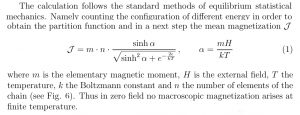
Ising’s main work in the 1920’s was deriving a mathematical explanation for ferromagnetism, the ability of atoms in certain solid metals to develop aligned spins, and exhibit permanent magnetic fields in there surroundings as a result.   The part of that might be of interest from a pattern science viewpoint is how his model has been successfully applied to numerous collective phenomena, both other emergent collective atomic behaviors like magnetism as well as emergent collective macroscopic behaviors like the emergence of organization in crowds.

Ising’s general equation

The math, honestly, is beyond me, but there’s an interesting assumption in the work that might be discussed from a pattern science perspective, that the math rests on treating such phenomena as arising from purely local interactions.

Ising Said: “So, if we do not assume [ ] that [ ] quite distant elements exert an influence on each other [ ] we do not succeed in explaining ferromagnetism from our assumptions.  It is [thus] to be expected that this assertion also holds true for a spatial model in which only
elements in the nearby environment interact with each other.”

What I suspect is that there’s more of a wave/partical type duality present, involving both local and contextual interaction
in bringing about collective organization.

In the collective phenomena we observe there is certainly has a strong local character, whether it’s snowflake formation, ecologies, social movements or probably also the punctuated equilibria of emerging species.  All such collective phenomena seem to arise in relatively small centers and then spread mysteriously.  They also seem to require specially primed and fertile environments, as global conditions that are receptive to the local accumulation of collective designs.

So my question is who else is talking about this pattern of nature.    Is this raised in Christopher Alexander’s “The Nature of Order” or other pattern language writings?   Is it raised in the work of anyone else writing in the pattern language field?  More specifically, does it need to be understood to know how to describe the contexts we work in, perhaps such that a calm and receptive and so fertile context is needed to be a good host for pattern designs to flourish?

___________________

jlh

Regions Left Behind

The discussion of the UN’s  Sustainable development Goals (SDG’s) focuses on the poor, and “Leaving No One Behind”.   That overlooks that it’s most often the growth of the world economy that made older parts of the economy outmoded, and leaving whole communities behind as the world economy moves on to what’s more profitable.  This discussion illustrates more of the detail, how innovative change like the “green revolution” thought to be for feeding the poor.   It would quite predictably also leave more and more agricultural communities behind, …as everyone has increasingly seen in their own regions… like in my own home region of New York State, exhibiting common symptoms of being economically left behind you see around the world:

  1. abandonment of rural communities
  2. as farmers can’t afford sell to feed their own communities
  3. the flight to cities with now skills to sell
  4. the growing refugee and landless migrant populations
  5. growing youth cultures with little to do but to get angry
  6. or that are fighting over resources degraded by over use

And that’s only one of the kinds of distressed communities unable to keep up with the competition ans the most profitable invest their profits in becoming more profitable and more and more people can’t keep up.

A natural pattern of the growth systems is using profits to develop innovations that are more profitable, which of course also multiplies the disruption of the ways of life being displaced..., that we've called
1. & 2. A natural pattern of the growth systems is using profits to develop innovations that are more profitable, which of course also multiplies the disruption of the ways of life being displaced…, that we’ve called “externalities”, as if they didn’t matter, and don’t get counted. It leaves more an more communities behind at the limits though.

These all actively leave whole societies of suffering people behind in a way that is not reversible.   It’s the real predictability of ever escalating competition causing all these uncounted impacts of how we invest money in growth for the wealthy, that undermining the sustainability traditional economies.   That’s the real quandary here, it so very predictable.    What DO development planners think about, not to ask who the latest innovation will put out of business.   Well, to do real sustainable design, we’d need to add that question to the list, what will our “killer app” put out of business?    It’s always a trade-off when you “create jobs” of any kind, that there will be jobs lost elsewhere with a very high probability.

Conceptually the lasting profitability option is fairly simple, gradual stabilizing of the whole system profit as the profitability of growth stops growing as fast, leading to a steady state creative living.

The Lasting Creative Spira, so familiar in life, only requiring that investment not be compounded as growing innovation meets diminishing lasting returns.
3. The Lasting Creative Spiral, so familiar in life, only requiring that investment not be compounded as growing innovations meet diminishing lasting returns.

________________

For the big picture of how we got the math wrong…

The economic impacts we don’t count turn out to be the great majority of disruptive earth and societal impacts we experience (seeImpactsUncounted ).  They even have a name, the “externalities” incurred as liabilities of obtaining services by paying someone else to deliver the goods.   So those are actually internal to the operating necessities for running a business, only external to the accounting we’ve been doing.   Counting them is actually just ruled out for SD accounting, by a “stroke of a pen”, as effects that decision makers don’t feel responsible for, and have no direct control over.   Those include impacts of financial decisions, for investing in disruptive innovations, also excluded from the discussion of impacts by the stroke of a pen.

Some impacts of finance are easily measured and some not, so to fully understand the problem takes sorting through what is accountable and what is not, develop different ways of assigning shares of responsibility.    Certainly the ones that are measurable should be counted.  They’re mostly counted globally, like soil and water depletion and lots of other things.   They’re just not at present assigned to anyone’s responsibility.  Doing so proportional to share of world GDP would be both scientifically correct and perfectly fair.   So a study group would pick one or two such questions at a time to see what can be learned.

Another concern is how the continual compounding of profits forces everyone in the economy struggle to keep up with financial demands for ever increasing productivity and competition…  what the phrase “the rat race” technically refers to.   It’s why we all seem forced to to run ever faster to stay in one place.   That’s of course not really sustainable, but very hard to know how to measure.   Still, it’s a very real kind of suffering and accumulative culture change, and connected to the escalating competition in the economy that leaves ever more people and communities behind, a kind of “destructive creation”.

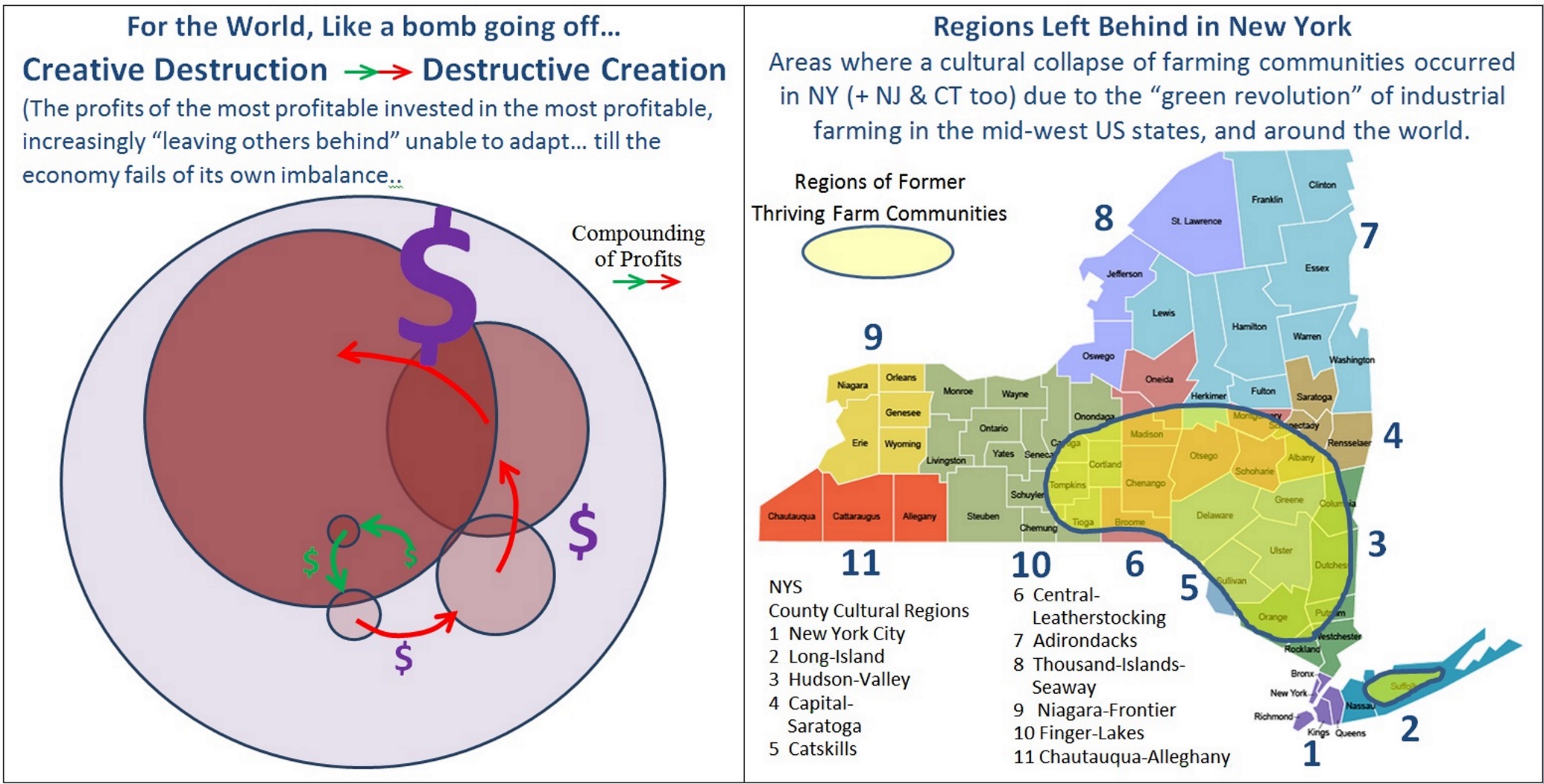
In figures 1 & 2 illustrate how regions are left behind, using the example of how once thriving agricultural communities of New York State collapsed, leaving long term economic damage behind.   The question is where did the money go that once invested in productive farming in the region.   The costs were left behind as the money fled to create the extractive industrial farming of the mid-west and elsewhere, mining water and fossil fuel resources very unsustainably, to grow corn, wheat and soy where it wouldn’t thrive naturally.  Of course, much of this is only observable in hind sight and not really manageable, but the costs to society clearly also do escalate.   That makes it imperative we take responsibility and do what’s right.    The driver is making more profits, for investing in even more competitive businesses, using “disruptive innovation” that also leavea ever more others behind somewhere too.

For many decades people have more often called that effect of disruptive innovations “creative destruction”, accepting that to make more money and increase the economy’s products, you have to destroy the economy’s old ways of making products.     The hard question is when to change from calling that  “creative destruction” to calling it “destructive creation”.    The programming of the economy to always grow that process seems to assure ever stiffer competition for everyone, all the time.    It’s so constant we might just take it for granted,… but as a continual culture change for pushing everyone to face ever stiffer competition for how they live, it’s certainly not sustainable.   As you push the limits then… it seems to naturally leave more and more people and environments behind, and be really more destructive than productive.

How that escalates is illustrated below, alongside the map of New York State, roughly showing the area of Central NY farming communities that vanished in the 50’s to 70’s, giving in to the competition from industrial farming.    We could count the region’s lasting economic and cultural damages, perhaps.   We can also see that the global corollary is of larger scale and seeming leaving more and more behind around the globe all the time.   We can see it was no one’s political decision, nor is there anyone else at direct fault.  We can see that kind of change is quite irreversible once it has happened.    We’d only know if we counted it, and attributed the costs to our financial decisions to profit that way.   As societal collapses are not reversible, we’d really need a more holistic way of measuring our impacts, to understand the costs of how we make money for our future.

Its SO predictable!

What would make people care??

What would let them notice??

Guiding Innovative Change – Holistic applications of the SDGs

Re: 18 – 21 Oct 2016    Addis Ababa, Ethiopia (research ref’s at the bottom)

Fourth meeting of the IAEG-SDGs

SD indicators need one more, the World SDG
so Innovators can design their goals
in relation to the whole

My comment is as an expert on both system design and natural science indicators, on how innovative organization develops in both natural and intentional complex systems.   There is a great depth of professional design practice that has yet to be consulted regarding the plan for the SDG’s

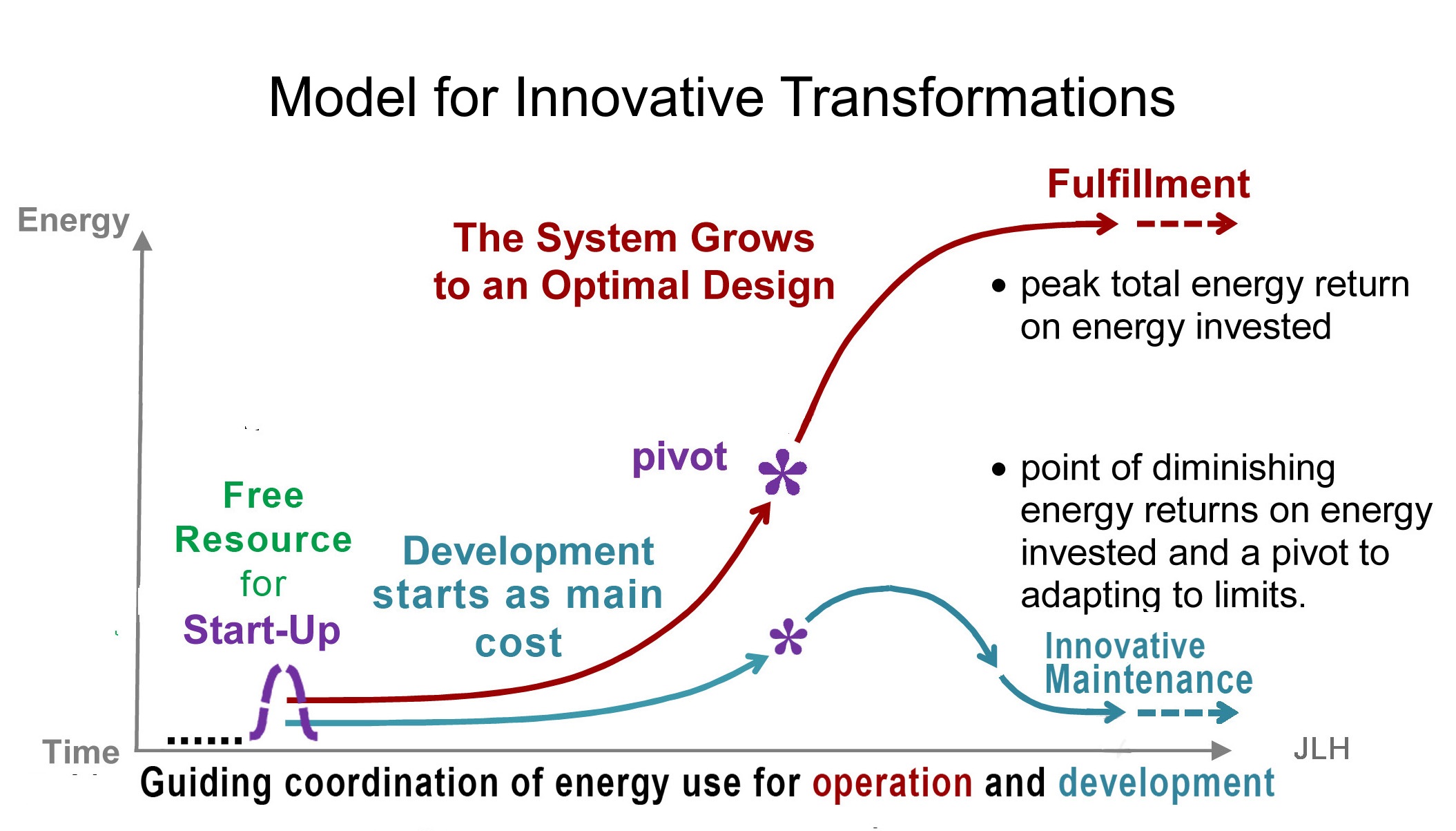
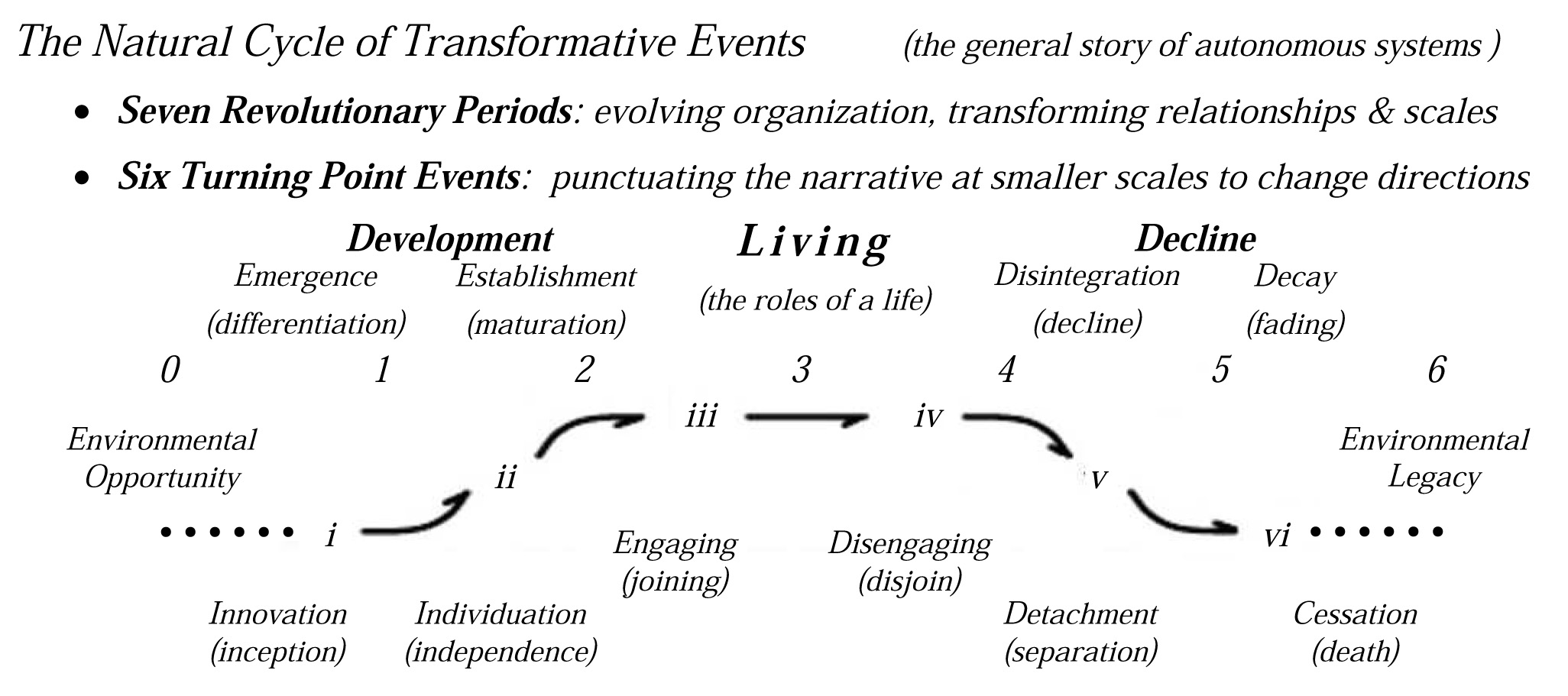
The general model of innovative transformations is that the emerging culture change, starting from some “seed pattern”, and then going through the classic phases of their own life-cycle of internal growth and changing roles in their environment (fig 1).  There are of course many kinds of invasive systems and life-cycles.   The type we are most often concerned with innovative transformations of human design, whether our own educations, or our society’s struggle to become “sustainable”, succeeds or not.

The earliest visible pattern is the emergence of an “inspiration” or “design”, looking for an opportunity to take hold, to have a starting organization that gets going by using environmental energy for building up the design.   That energy flow for formation then tapers off as the transformation progresses, toward refining the “new capability”, or “new culture” or “new business” etc.

The natural goal is generally to stabilize the design as it begins its real work at a peak of vitality, beginning a long productive life.   So in general, it’s to first grow and then make a home, to have a life.   This model developed from study of natural change patterns , applying constraints of physics principles for energy use, that for designs to develop or change they need to develop new energy uses too.

Fig 1. The stages of organization to build systems and their energy uses

I’ve been attending the UN SDG meetings for four years, first for the Institute for Planetary Synthesis, and then with CIVICUS, learning a tremendous amount, but also noticing the very distinct lack of systems thinking in the design of the SDG’s.  The main reasons seem to be that systems thinking is not taught in liberal arts educations, and that the design of the SDG’s was mainly shaped by demands for change, by issue focused groups from governments and civil society, not experienced with how organization relies on designs to join differentiated parts.   So ideas of how to organizing the differentiated parts when undiscussed and were mostly left out.

So the process produced 17 idealistic “goals” and 36 main “topics” discussed mostly separately, arising from a profound concern with the whole global pattern of culture change and economic development. Personally I had a wonderful time, but was also sad I never got to talk about my main expertise, i.e. on how the parts of whole systems connect.   From a natural systems view the SDG’s may be spoken of as separate,  but are all indicators of “holistic cultural growth”.   They’re not really indicators of “economic growth”, as it’s whole culture growth that brings value to an economy not the reverse.

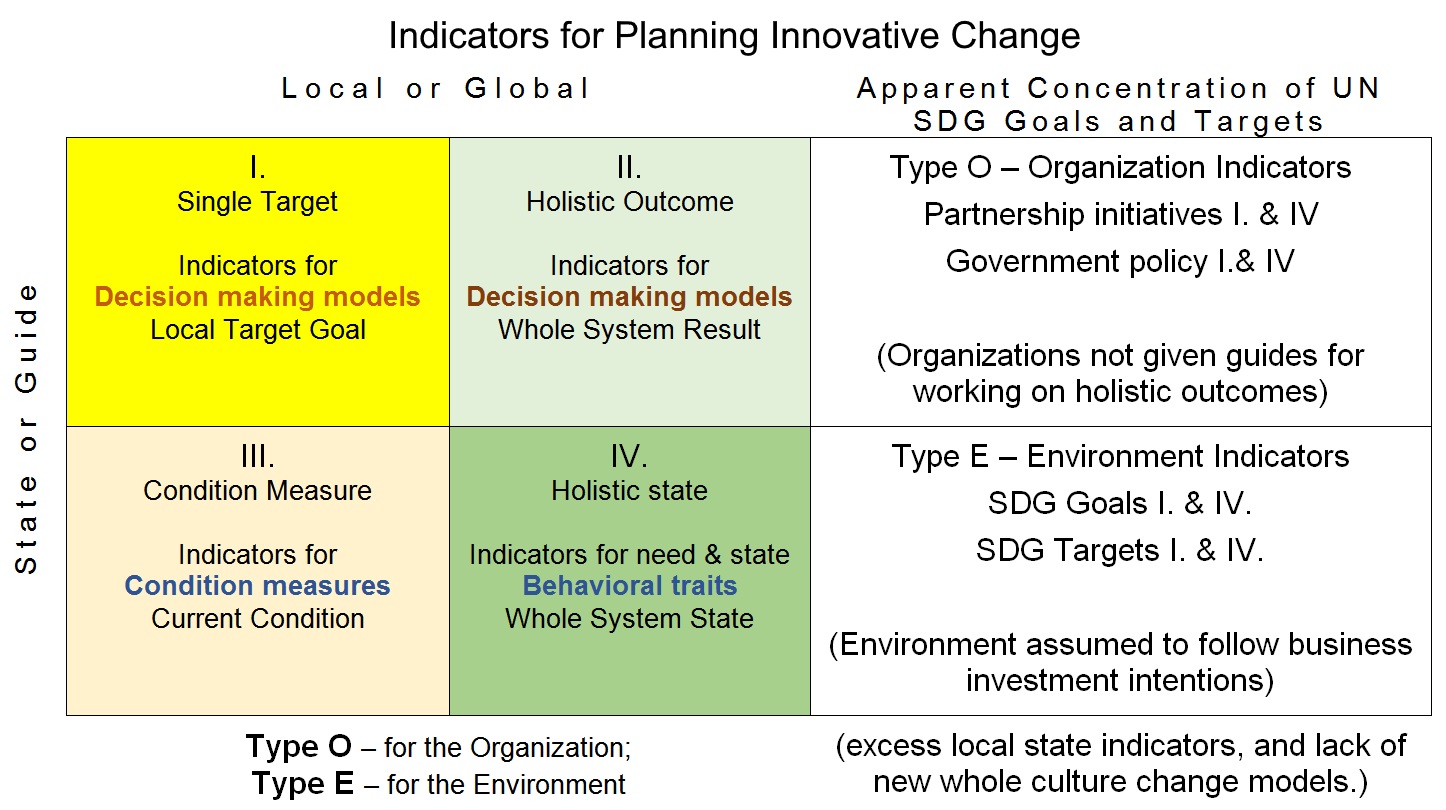
With the process lacking systems thinking resulted in missing systems indicators: for how differentiated parts connect, for how cultures develop unity and cohesion.   The diagram below is mainly for study, a “sense making tool”, a “map of questions” to help guide innovative changes.

The challenge is our usual mental confusion, with our minds working with disconnected bits of information and but actually working in holistic organizations and trying to engage with holistic systems of our world.   So our “maps” and our “worlds” show a “mismatch of variety”.   So we need to constantly study and learn from new experience.    To succeed with an SD partnership, the organizers first need to find a “start-up match” between its “own abilities” and “an environmental opportunity”.  Usually it takes “a study of the context”, identifying “forces to make whole” with a “unifying response” ( a reference to “pattern language”) .   In terms of the 8 kinds of indicators for planning change, it’s matching type IV indicators of whole system potential, one set within the organization and the other in the environment.   The actual initiative might focus on one or the other…

The 4 quadrant map  has “condition indicators” for “states” (how things are) and “guides” (what can change).  It has “context indicators”,  “local” and “global”.   The four quadrants are repeated for the Organization and the Environment as a 3rd dimension for the array.    This arrangement borrows a bit from David Snowden’s Cynefine “place” centered holistic complex system business design practice.    It fits with the long lists of indicators of functionally different kind needed for the SDG’s

There are also other advanced holistic system design traditions to choose from.  In all of them design proceeds in “stages” of team “learning”, “work” then “review”.   With each cycle all the indicators being worked with are reviewed.   All the indicators the organization uses to guide it are consulted in the learning phase of each cycle.    The architectural, product design and performance design professions have ancient traditions of how they do their work.   Newer traditions of system design where this kind of learning is studied include “action learning”, “pattern language”, “object oriented design”, and “permaculture”.   None of these traditions of advanced design practice seem to have been consulted for the SDG’s for some reason.

Fig 2 Three dimensions of planning for innovative change, Organization & Environ, States & Guides, Local & Global


I do hope the above is helpful
for where SDG implementations can go for advice.

My real reason for writing, …and offering this way of understanding transformational change,… is the oddly disastrous pattern of excluded indicators in the official statistics for the SDG’s.  The measures of ESG impacts that businesses are told to report as measures of their responsibility, have many more exclusions than inclusions.

It is possibly unintentional but oddly very boldly “hidden in sight”, the clear exclusion of all responsibility for the disruptive impacts of business and investor money decisions.   It comes from the modern continuation of the ancient practice of excluding all business responsibility for economic “externalities” of the choices for what to profit from.   Some impacts of what to profit from no one in the past would have know about.   Now we really do know most of them.

The very largest exclusion from business impact reporting, though, is one that anyone would always have known about.   It’s all the human consumption that business revenue pays for to obtain human services, ALL of it, as if those impacts had no environmental cost.   That one accounting exclusion is commonly five or ten times the impacts the rules say businesses should count.   The indication is that we have not started doing any form of sustainable development yet, systematically making decisions as if 80-90% of the impacts don’t exist.

At the UN and in writing to people I’ve been finding most people understand all this fairly quickly, …but then avoid engaging in discussion, the worst of all possible responses for our world.   The cover-up and avoidance is always the bigger crime.

I urge you to respond to the challenge.

There’s a simple way, too,
include in SD reports one new indicator,  “global share of GDP impacts” proportional to share of global GDP

It’s really important to start the discussion.

Thanks for all your dedication and work
Most sincerely,


Jessie Henshaw

______________

The next more detailed introduction,
to the “mostly uncounted” SD impact indicator problem, with references.

fyi  –

I’m writing as a scientist, and expert on the design of natural systems and natural science indicators.   I had wanted to attend the Ethiopia EAG meeting on Indicators, due to the major neglected issues I need to raise.   Not having a sponsor I thought to pass on some of it to others who may get there.   It’s about reliable filling the unusually large gaps in the SD impact indicators used for decision making.

As a consulting systems scientist I’ve has been attending UN meetings for four years, observing the SDG process, and noticing the big gaps in systems thinking being built into the plan.   One in particular is that our impact measurement methods are not holistic, but actually quite fragmentary.   Just having better information on visible impacts won’t tell us about the growing system-wide  impacts, so SD decisions will still be unable to avoid traditional pitfalls of economic planning.   Going ahead with just fragmentary indicators could really then make the SDG effort backfire, perhaps badly, adding to the “externalities” of the economy not reducing them.

That we are not yet doing holistic impact assessment is fairly easily documented, as whole categories left out of the accounting.  There’s  an amazing list of things the economists (at the direction of the OECD it seems) have arbitrarily left out of the list of things to count.   The peculiar result is that the exclusions add up to nominally 90% of the real total.  The biggest category of exclusions is usually the largest category of business environmental impacts.  It’s the impact of paying business people for their human services, and for professional services, financing and public services.  As a result SD decisions to maximize profit are being made unaware of nominally 90% of the future impact costs of those decisions.   It’s surely a long standing habit we can’t change all at once, but we desperately need a recognition of it.

The economists have historically counted the business impacts as only things the business specifically directs.  That then treats the “consumption for production” of human services as having zero impact, the usual largest of costs and of lasting environmental impacts of any business.  The same is the case for all other supply chain impacts that are packaged as “services”, all counted as having zero environmental impact..    Having so little information on the lasting direct costs of business profits has always been a problem, and when combined with not feeling responsible defining “business as usual”.   Today SD decision makers are still trying to maximize returns with a similar lack of information, though, as if just feeling responsible would compensate for the misinformation.   It doesn’t.

I think most important is not to pick fights but to raise discussions of our common responsibility to address our common interests, to begin to include ones we’d been blind to.  The caution is that It’s common for people whose sight is suddenly restored to be in shock, so it’s caring for them not making demands that lets them see.

If you or others would like to follow this up, you might start from watching my video comment to the UN on July 11 (1), and read the short  “Impacts Uncounted” circular (2).  I found it very effective for explaining the details when talking with people at the UN.    There’s also a quite surprising scientific solution that makes holistic accounting possible, first reported in a peer reviewed 2011 paper (3).  How to use that principle that “shares of the economy are directly responsible for shares of its impacts”, because of globalization, actually, is shown in a general 2014 proposal to the UN called the “World SDG” (4).   It’s not getting discussed much yet,  apparently due to the shock.  Another caution, of course, is that we need the old economy to build the new one, part of why transformations are complex.

The big mental shock seems to be realizing the lasting impacts of using money are not close to “zero” at it appears.  They’re actually very likely close to “average”, for being so unusually widely distributed the way an efficient economy works, that to do most anything takes everyone’s service.   That “reassessment” is an almost infinite change of scale in our responsibilities, after all.   It directly connects what we do innocently with money with all the disruptive things the economy increasingly does as our growth model collides with the limits of the earth,  ..hurting the distressed communities the most.

So what we need is for people to keep doing what they’re doing, and begin to assume they have a real responsibility for what’s going wrong with the economy and the world, in approximate direct proportion to their share of the economy.


I hope that connects with your thinking and gives you a start with mine.   Please send me anything you think is relevant.

Good luck your good work!  Thanks so much for your time.

  1. JLH at UN HLPF – comment on Growth & Impacts Uncounted, 11 Jul 16
    https://www.youtube.com/watch?v=CxSmEixz5WQ
  2. Impacts Uncounted circular
    http://www.synapse9.com/_SDinteg/ImpactsUncountedl.pdf
  3. Henshaw et. all. 2011,System Energy Assessment (SEA). Sustainability 2011, 3(10)
    http://www.mdpi.com/2071-1050/3/10/1908/
  4. World SDG proposal
    http://synapse9.com/signals/2014/02/03/a-world-sdg/


JLH

NYC data Science examples

1 The End of Crack and Breakout of Hip-Hop
2 The US economy’s separate tracks for rich and poor

To help people understand my work, here are a couple of examples of data science to discover dramatic recent culture changes in New York City. The work is based on a careful lifelong study of eventful natural change, of all sorts, done by following the stages of growth and decay evident in the natural life cycles of culture change events.

following the stages of growth and decay evident in the natural life-cycles of culture change

My method depends on finding data that shows clear evidence of growth or decay, as those identify natural processes of irreversible organizational development, in the natural successions of change.   Below are samples from two advanced studies of unexpected dramatic societal change, and a drawing of the markers of change I use to suggest what evidence to look for to discover what’s changing.

The two advanced studies are the mysterious 1991 collapse of the great NYC crack culture (1), and second, the mysterious 1970 splitting apart of the US economy into rich and poor sectors on different tracks (2).   Both were simply enormous cultural events that very largely went unnoticed, dramatic “break-outs” of culture change that had been brewing for a long time, and then swiftly changed how we live.   The study of the collapse of the NYC crack culture and many other examples are in the archive of my research from the 80s and 90s called “The physics of happening

It gets easier to discuss these cultural changes once you sense what is being opened up to view is really the stories of our own lives.  These and patterns of change in things we are all talking about anyway, only with data showing the systematic progression of key measurements of them. The basic science for following markers of change, implied by the physics principle of energy conservation (3), implying that lasting change is a process of organizational development.  So the markers suggest places to ask “what’s developing”.

basic science for following markers of organization change, implied by the physics principle of energy conservation

the markers suggesting places to ask “what’s developing”.

1.
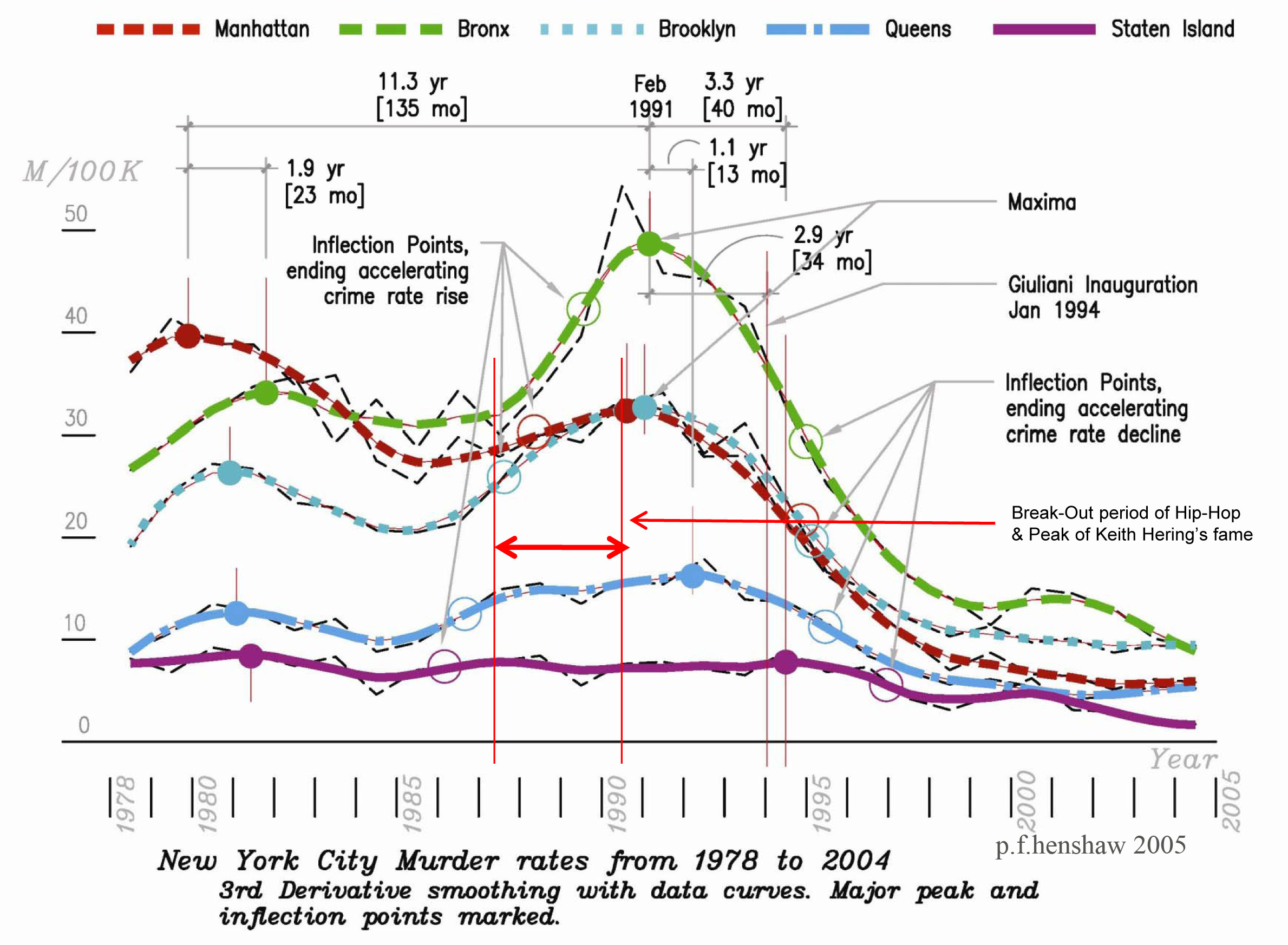
The End of Crack and Breakout of Hip-Hop

… three years before the mayor who took credit for it took office. The real main player was the strain on the families of the NYC drug cultures involved. They had become particularly traumatized by it, and the rest of society desperately searching for some way to change too.  Everything people wanted to have work started working all at once, when their kids stopped looking up to the drug lords!   They turned to the emerging Hip-Hop mass culture as an exciting alternative to be part of, a riveting story when well told.

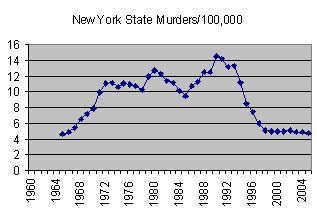
What tipped me off was the “decay curve” shape of the NYS murder rate data shown in the NY Times. The abrupt decay curve shape, rapid at first and decelerating over years, without wiggle, is a very clear indicator of the death of a natural culture, in this case seeming to be from the youth that had once fed it turning away..

2.
The US economy’s separate tracks for rich and poor

… a sudden structural change in how the US economy worked that broke out in 1968-70.  A huge transformation occurred in how Wall Street defined profit, shifting from Wall Street seeing its role as helping businesses create value, to seeing its role as taking profit from business for shareholders.  [note:…the strong appearance is that it actually changed the “polarity” of wealth management, in effect violating all of Asimov’s laws of robotics at once, as the first major use of computers for business to robotically take profits from business for shareholders (and traders)].  That shareholders and everyone else didn’t know maximizing the extraction of wealth from businesses would end up driving businesses to impoverish society… is of course the catch.

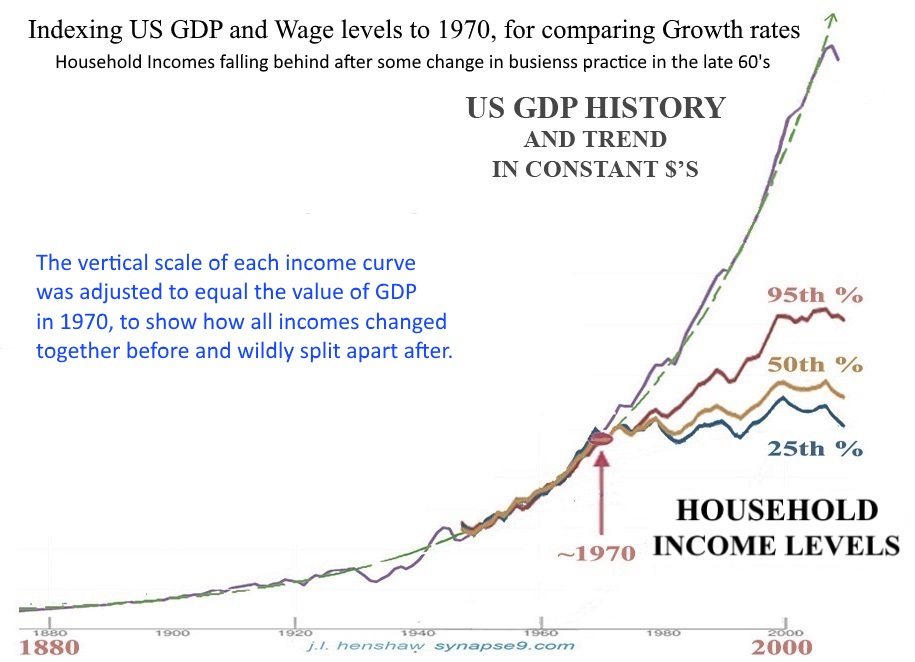
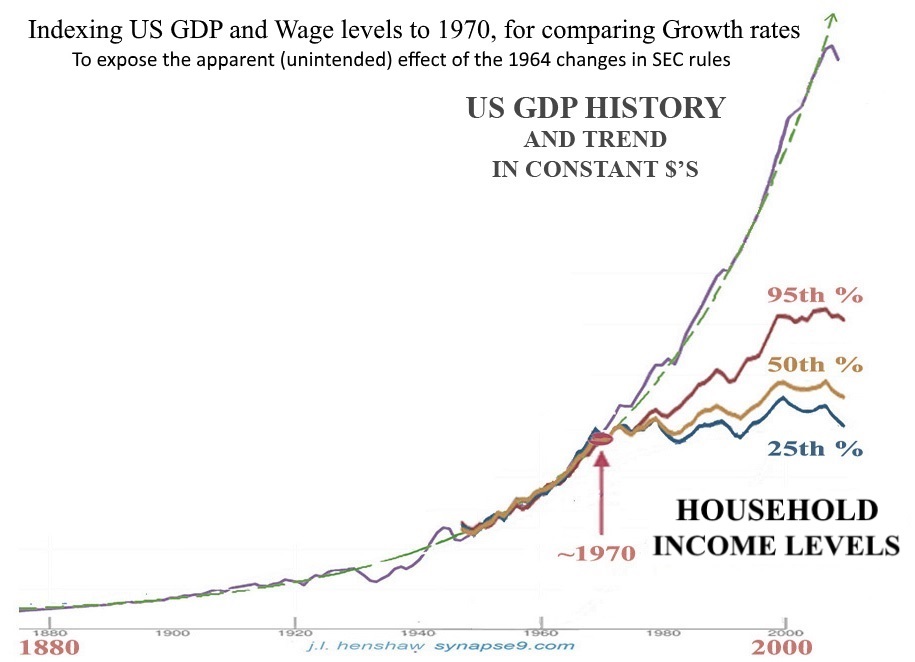
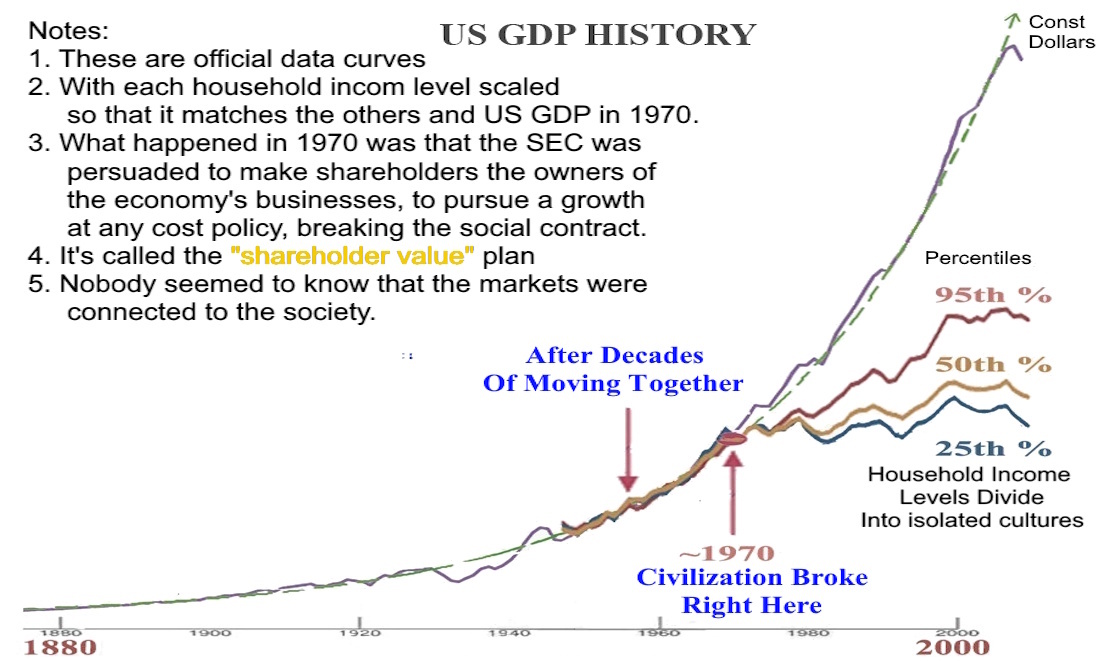
The curves here mainly indicate that something enormously big happened.  The US data for median household incomes is “indexed” to US GDP (scaled to equal) at 1970, the time when the whole system behavior change occurred.  GDP represents the whole economy’s income, that as the data also shows, before 1970, growing at the same proportional rates as the median incomes.  It was after 1970 they all then split apart, with the GDP doubling and doubling while the median household incomes fell farther and farther behind.

3. The “Life-cycle Markers” derived from the physics principle of “energy conservation”

…that implies it takes organizational development for energy use to begin or end. It helps make sense of the way regular proportional change (what growth and decay curves show) is so commonly present where lasting change occurs.   Once you begin to ask “what happened” where lasting change takes place, you look for the evidence of organizational changes taking off. and changing directions.

jlh

Scientific Community on Natural Limits

Post event note:

UN meetings on the first year of SDG implementation are over now, were very intense, and in the end quite successful for finding a new way to discuss the neglected issue of natural limits.   The scientific community that understands the connection between our natural limits and economic growth has been totally shut out of the UN discussion for years.   I didn’t get to speak to the main body on that directly, but I finally found a way to talk about the problem, that the SDG’s don’t in any real way count the global impacts of our decisions:

S D   M e t r i c s   L e a v e   M o s t   S o c i e t a l   I m p a c t s   U n c o u n t e d  

It’s to say:

The ISO’s world environmental accounting standards
fail to honor its fiduciary duty to our interests and human right to honest data,
only counting local impacts, leaving all global impacts of financial decisions uncounted and unaccountable.
SD decision makers are the most hurt, kept from knowing most of what they are deciding.

____________

The 17 Goals

It had seemed I would have a chance to speak at the UN, officially representing the long neglected interests  of the scientific community that understands the coupling of the economy and natural limits.  Below is the email I sent a number of scientists and other experts who understanding is not being represented:

Friends,

I found a way for scientists who have long understood natural limits, to get official representation at the UN, in the UN’s community of CSO’s (Civil Society Organizations), as a member of its “Major Groups and Other Stakeholders” (MGoS).    The present work is the review and guidance of the UN’s global Sustainable Development Goals project (SDG’s), and the High Level Political Forum’s (HLPF) oversight of it.   https://sustainabledevelopment.un.org/hlpf

Please circulate widely.  Non-expert members welcome too.   There is no organization at this time, just me seeing an opportunity to have our long neglected interests given official recognition.  I might start a Google Group with the names or something…  Any statement would be in the interests of the group rather than as if representing a group position

The draft text for representing the group’s interest to the UN is is here.

Time was too short for it to get around, and response was slow, except for the two  great ones I really appreciate getting, so I turned off the Google invitation form .   It still seems to be something that community really should find a way to do though!

Jessie


Was Shareholder Value What Did It??

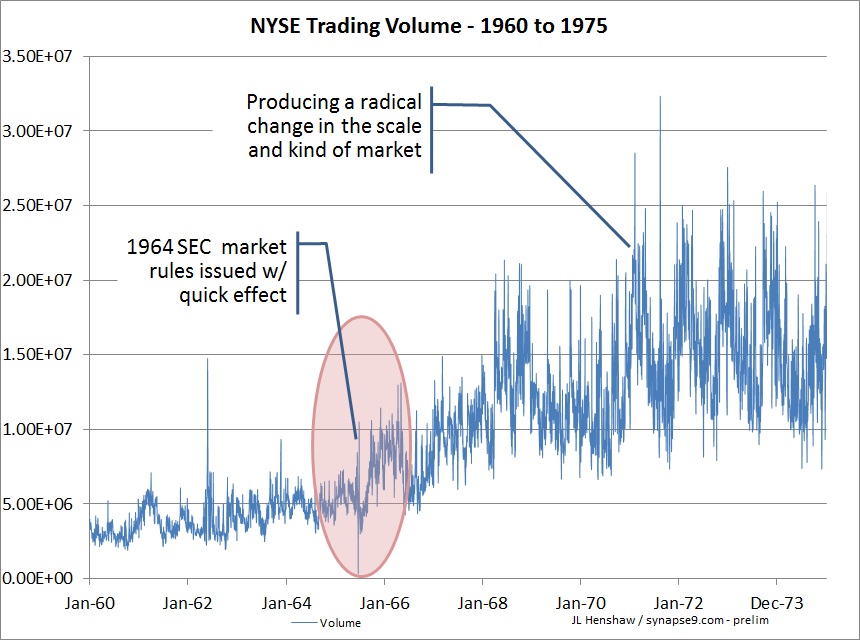
Preface:   The 1964 SEC rules change seems clearly connected, but what really happened to so dramatically change the whole economy at the end of the 60s??   Figure 1 below shows that something DID abruptly change the whole future of the US economy, in about 1970, causing a permanent great acceleration in societal inequality.   Figure 2 below also clearly shows that the pattern of trading on the US stock market began to radically change in 1965, too.   There’s also other evidence mentioned below on what happened.  The Marketplace.org radio program 6/14/06 gave another part of the story for the evident sudden change in the relationship between Wall Street and Main Street.   They said it was what Milton Friedman wrote in the NY Times in 1970:

  • The big change began with a professor. At the University of Chicago, economist Milton Friedman (who would later win the Nobel Prize) wrote this in the New York Times Magazine in 1970:
  • “There is one and only one social responsibility of business — to use its resources and engage in activities designed to increase its profits.” [and as it worked out, destabilize civilization in the process]

The coincidental magazine article almost fits the data…, but when did a single comment by an economist suddenly change the world?   Never, of course.  I think it had to have been deep changes in the rules of business, perhaps then formalized by the SEC, such as with its rule change of 1964.  The suddenness of the break in 1970 indicates that considerable pent-up pressure was released all at once.  The smoking gun is that the bottom 95% of household income levels suddenly went from growing together with the whole economy to splitting apart. 

The result is a rather sudden reprogramming of the entire relationship between business and society, though.  We were computerizing and trying to streamline everything, standardizing new business and stock market accounting methods, etc., so that would have to be how it all got connected, and went miles beyond what most people would have ever imagined; giving the ownership of business and all the money to a community that was only playing games of multiplying propfit with no other interest in heart. 

The “bottom line” somehow merged with maximizing “shareholder value” for people whose interests seemed to be totally unconnected with real-life values of any kind, only percentages.  Those changes would seem to have served anyone being paid in proportion to profits, shareholders, stock traders, executives… and to disadvantage everyone else.   [1/1/2018, ed 2025]

_______

For those less familiar with my work, I study an evolutionary development form of physics, using explanatory principles to ask leading questions about how complex systems rapidly reorganize and change form, perhaps the most wonderful, frightening, and inexplicable thing nature does.   The clue is that such changes are generally associated with rapidly expanding organizational designs during growth.  Other scientific methods treat the shapes of these “curves of emergence” only as changes in numerical scale, thereby totally misrepresenting what is really happening, all by itself.   Much can’t be explained, but what can be firmly predicted is that any growth process produces a crescendo of change, one that will upset its own process of change, forcing the system doing it and its design to change form.   We should all learn to study that transition.

Earlier writing on it is below, leading up to the one thing to take a close look at, the details of how Shareholder Value apparently caused American civilization to splinter, becoming more and more oppressive to the makers of the economy.

_______

2016 forward:  

In the figure below, the economy as a whole is shown continuing to grow as before, while the various levels of household income suddenly split apart.

Whatever the change, it would clearly be catastrophic for the resilience of wage-earning communities.   The question remains: What kind of cultural change is exhibited in the data?  Was it, as I’ve suggested, made possible and facilitated by the comprehensive SEC  and Congressional revision of the stock exchange rules in 1964?   Outwardly, the SEC’s purpose was to bring the markets into the modern world, to make it more convenient, secure, and efficient for ordinary people to invest and make money from a growing economy. The exact opposite happened, though. 

How systems can change behavior rather suddenly, as we all know from personal relationships. There are always hidden variables and surprising effects from new connections, like building a bridge. Perhaps nothing much happens, or everything changes suddenly. Many other things were happening in the context as well, as seen in the real-time trading data (2), which showed a sudden change right after the rule change. and then took off in other directions as quite new behaviors in the NY Stock market were experimented with.   There was an immediate wave of high-volume trading, unlike anything in the past, seemingly ushering in a culture of fast and high-volume trading as a new way of “playing the markets” that may have been intended, or may have been a big surprise, but certainly changed the world as a whole since.  

It notably also included a redefining business value for the sake of the markets, as a single number, “the bottom line”, introducing the widespread use of the term to represent a new way of market-savvy for abstract valuations, ensuring trades would be made based more on market psychology than on the organizational value of and service to its contexts of what is being bought and sold, that appears to have been what produced the prior period of stable valuations of business relationships and communities.

If you consider how it might affect businesses, being graded every month as succeeding or failing, and having to constantly raise their finances against the “making the grade” set by market anticipation of business value, it’s clear what a terrifying force it might become.  That one little side-effect of the new rules might be 90% of the reason the markets causes all sectors of society to split apart and, led by very sloppy thinking about value and severly opressing the working word doing the rearl design and assembly of what the markes keep bouncing all around, this way and that, always pumping things up to be the firts things dumped the next season. It’s sure no way to run a family, and a family is what an economy physically is and behaves like it up to the year of 1970 when it splintered into bought and sold parts with no inherent value. CEOs and boardrooms across America would be compelled to make decisions that align with market expectations, regardless of the impact on their communities.

 It seems some center of business thinking was discovering how much profit could be squeezed out of the economy if business was managed by computer for that purpose, you know, just thoughtlessly driven to maximize some equation, whatever it did or didn’t mean. Was that what created the pent-up pressure that the new rules for rapid trading allowed, as soon as it became possible?   It would change business and investor decision-making, no longer managing the development of their cultures, just squeezing them harder and harder, much like school teachers forced to “teach to the test.”  

As we know that drugs can raise performance till workers and families break down too, which investors would be unaware of. Teaching to the test simply hollows out the student’s education, doesn’t allow their interests in the world to be their guide. Driving American businesses to meet the numbers, to please Wall Street, would have the very same corrosive effect and be very costly.  Driving stock price increases with continual forced “efficiency” and “productivity” gains naturally drains a system’s resilience, too, a kind of enslavement, and very real cause for resentment, and crumbling relationships that may be invisible till too late. 

_________________

The first versions of this study, in 2010:

My first notes on the subject date back to 2010.   You can find lots of examples of complexity itself being a natural limit to growth, and I initially associated this change in how the economy worked with the rapidly emerging complexities of life.  We all experience life as a growing struggle, an escalating “rat race” of new complications, and a constant search for simpler answers.  Clear evidence is found in the sudden rise in use of the phrase “information overload”, from the late 60’s on.  At the same time, there has been a slowing use of the word “complex”, which I think indicates the complexity of things stopped being of as much interest.   Those issues are discussed in: Complexity too great to follow what’s happening… ??   

Then in 2012 I realized 1970 was also when computers started being used to manage business complexity, as the first “killer app” of computing really.   The global effects would include giving business management a growing information advantage over others, telling them what can be cut and remain profitable, and making business financial analysis based purely on numbers rather than judgement, and somewhat incontestable, as discussed in: Computers taking over our jobs and our pay?

These preliminary studies still seem valid, but fairly incomplete.  They didn’t really explain why the change occurred in 1970, or why so sharply.  That is what the SEC rules change of 1964 now helps to provide.   It appears that the implied “fitness function” of business was redefined to advantage the stock markets and executives, and hollow out the economy for everyone else, in effect violating all of Isaac Asimov’s laws of robotics, as the first big thing we thought of doing with automation.

_______________

The Rules That Wrecked the Economy

It takes a little time to explain the evidence, here showing the long record of US GDP growing by leaps and bounds for 120 years.   Overlaid are Household income levels, scaled to equal GDP in 1970, so their proportional changes are displayed.   Household incomes are seen moving all together, all changing in proportion to GDP…. from the 1940’s to 1970, but then start to dramatically fall behind.  It shows the economy completely stopped “lifting all boats” in 1970, completely disproving the endlessly promoted business lobby idea that how to cure for the “malaise” was to give the rich more (nearly all) of the money.  

Households suffered from having to manage the ever-faster-growing complexity of life, but without the growing resources or time to figure it out.   It might not have been intentional, maybe just blind, but these trends do seem to literally display 40 years of US households being increasingly devalued, cheated out of the economic value they created, even as investors were cheated too, by businesses being driven to develop unsustainably, only becoming a great public issue now.

US GDP growth & US Income Levels falling behind, Incomes are scaled to 1970 GDP to compare rates, following GDP growth to 1970, then lagging and splitting apart. (This is the Original Version)
The 2025 update: A global tragedy caused by Milton Freedman and the Republican Game Changers persuading the SEC to give shareholders ALL the money.. Well naturally, they’re supposed to be the ones who know what to do with it… RIGHT??

The next figure shows the behavior of the stock market at the time when the SEC rules bringing “efficiency” to fast trading and market manipulation by traders, a 14-year record of NYSE trading frequency beginning in 1960.   You can clearly see how the strongly patterned trading followed immediately after the rules were implemented, marking a dramatic change from the previous, sleepy manner of trading. You might also be curious about the 40 year record, from 1960 to 2000.

A 14 year record of NYSE trading frequency showing a dramatic change right after the new 1964 SEC trading rules were adopted.

When you see a genuine behavior change like how the trading volume suggests a “sleepy” market from 1960 to 1965 followed by a market of manic movements thereafter, it means people have really changed what they’re doing.   I’m not completely sure how well my hypotheses about that behavior change will hold up, what it was and what effect it had.   I have a rather good record on a number of other things, though, so I think they’re at least rather close.

I would love to have help exploring more deeply how the culture change involved took place.  The SEC’s annual report mentions a number of meetings that may have been involved, and obtaining those notes could be very valuable.    The documents I found most useful so far are a 30 pg excerpt from the SEC Annual Report of 1964 and a NY Times article reporting demand for “the bottom line.”  The latter interestingly reports on the woes of bankers, as if not sure of how businesses define their values, as an argument for reducing the value of businesses to a single number in a quarterly report.  I think that way of redefining the value of businesses shows a clear “spin” favoring the fast-trading culture that is about to emerge.   It quite neglected the possible effect on the lasting values of businesses, and the devaluation of the people doing the work, which Wall Street thinking seems to have resulted in.

__________

Work to be done includes

  • updating the data from original sources
  • more detailed study of the 1964 SEC rules and their adoption, amendments, and “side agreements”.
  • studying why the rules were a pivotal  “breaking point” for a rapid large scale culture change in how American businesses are managed and how the new style trading cause business practice to change

No doubt, there would be grand-scale malfeasance discovered, and perhaps prosecutable criminality as well.   As what happened is really culture-wide, I think finding criminality would depend on when the original meaning of “fiduciary duty” was lost, which would be the basis of requiring financial managers to act in the interest of the people they make decisions for.   The main crime seems to be a self-destructive culture change, causing the markets to lose all sense of proportion, and the working classes being disenfranchised. Well, we thought we could get used to it, and now it seems we can’t. 

The ideal policy would be to guide people to understanding their own errors and learn how to follow a new path.   New York City, like all the “money centers”, is directly implicated in needing to find a new way to make money, for example.   For 50 years, money centers have depended on maximizing the extraction of wealth, not securing the future of wealth, and so have relied on promoting disruptive innovations with no heed to what was disrupted…  No fury seems adequate to express the stupidity of that.   What it does indeed come down to is finding that those money centers will shortly “be out of a job” unless they become as creative at helping to put the world back together as they were at ripping it apart.

Added work to do includes:

  • further studying the very special problems of societal manias…. as that is what we see here.  What sort of “policy” can one have for societies taking the wrong path, having wandered SO far from creating a world to live in that can last.

If you think of money as physical energy, money being what we use to release our use of it, you can think of the global economy as a rocket ship.   The problem, of course, is that our culture has settled on operating civilization in a way that resembles a rocket ship, programmed to accelerate and never land.   Our main societal “business plan” is to multiply our energy use, investing to accelerate our fuel consumption as fast as humanly possible, forever.   Of course, to achieve that, some money and energy are reserved for keeping people somewhat happy, but if the policy is aimed at maximizing growth rates, every other purpose is at least secondary, if not altogether irrelevant to decision-makers, the heart of the crisis.    

So here’s the question: how do we change course when changing course is nowhere in the plan?   Do we shove the drivers out of the vehicle?    Do we hope to explain to them the use of the gas peddle, steering, and brakes?   There may be equivalents in the rocket ship already, but the driver seems utterly unaware of these concepts.  It’s a lot to explain, and a lot to learn,

  • collecting our understanding of real scope of the problem

The ancient legal principle of “fiduciary duty” is a fundamental principle of professional practice, requiring professionals to act in the best interests of those they serve, and is another example of selective redefinition for managing money.   There is probably a clear history of successive misleading revisions, with a legal paper trail to follow on how it came to be turned on its head to serve mainly the self-interests of traders, who were paid for their extraction of short-term profits, rather than serving the interests of the people whose money they traded.    I appears that legal opinion now holds it to actually be prohibited for traders to consider anything other than short-term financial returns as the interests of investors, even though no one is served by that except traders and CEO’s who are paid in % of short-term earnings.  That is the complete opposite of the original intent, of course.    So the redefinition of “fiduciary” seems to have come from cultural blinders like those that produced the SEC rules of 1964, too.

Another, even clearer example I’ve noticed, I also spent a lot of time thoroughly documenting.  It’s how all manner of scientific principles are being willfully ignored in managing the world survival project called “sustainability”.

One certainly can’t fault anyone stumbling through this confusing time, making sincere efforts to learn about how our very complex world can come to work again.  We’re in a period of unprecedented permanent change in who we are, not planned by anyone, it seems.  That said, there are also large systematic errors one can find in the efforts people are making, related to the persistent distorting influence of money. We should have noticed long ago that it was an abstraction stripped of all context.

One very consequential case is in efforts to reduce environmental impacts that businesses are responsible for, using widely circulated, very unscientific rules for counting them.  The standard for environmental accounting instructs people to measure the global impacts of their use of the economy by what they record locally.   What is shocking is how that “slipped by” so many world institutions and professional communities.

People seem to be just told to never count the impacts of using money, even though that’s the main thing causing all our global impacts.  If you’re not allowed to count the impacts of money, it limits your view to your local boundary of observations.   So, sustainable cities don’t count the resources consumed from outside the city! Isn’t that so strange??

The same applies to national measures of sustainability, outside its national borders.   I’ve been publishing and writing extensively on this topic, and tying it all together in my UN proposal for a scientific method to steer world sustainable development, a World SDG.   It starts out very simple, learning to do the math right first, and leading to giving people a full understanding of what our money pays for.

I’ve also studied fairly deeply how all these confusions could arise.   Is there something wrong with our minds if our effort to hold onto reality is so fraught with difficulty?   What would allow the meanings of important words to unexpectedly change, largely unnoticed?   The line between words that are and are not prone to radical change lies between the words we derive from experience, such as those defined by things we can point to, and those we receive from other people based on abstractions, wholly detached from nature.  

Most old words directly refer to natural patterns of life and our own experience of them. That way, we cannot lose their root meanings as new variations on their added meanings accumulate over time.   The problem is with words defined conceptually, social agreements, and things like the economy that we can’t really observe, and so only understand abstractly. Being unable to distinguish between terms of conceptual thinking and terms for natural experience seems to be the problem. We seem to trust whatever usage of any kind is current in our personal circles.   So going between money worlds, or personal, social, professional, or religious communities. too, the same words may suddenly change meaning to conform with that circle’s conversation. That’s socially important at times, but is that EVER a confusing way to think about a world spinning out of control! People may create new abstract meanings for convenience that can then drift widely from one group to the next, meaning different things at every stop, the variation and disconnection to never be noticed.

That inability to distinguish between natural and conceptual meanings seems to spill over as part of all our problems.   We rely on natural and scientific language for grounding our ideas of patterns in nature, but we’re at risk if we can’t check such wandering meanings with their natural roots.   At present, though, the scientific meanings of natural designs and the natural meaning of scientific ones is only appreciated by a few and are rarely being taught, in much the way those presently disconnected subjects and discussed only in disconnected places, our scientific thinking limited to the classroom, lab, or office, and the meaning of our integrated life experiuences at home or with friends.  

Maybe we’d learn more if we made jokes about how impossible it is to frame each in the terms of the other. Then we might learn to see what’s really being distorted.

That’s more or less what I’ve done, collected some things I see how to tie back to nature any time I like, to double check, and help show where work is needed to get the story straight!   ;-)

__________

(draft in progress)

JLH