Category Archives: Policy discussion

Next thing to “make it in NY”?

Short version Voted a Top Comment on the Forbes article
The Stock Market And Bernie Sanders Agree — Break Up The Banks” ,
a
 more full story follows.

The reality of the matter is as embarrassing as it could be. If you trace it all back to origins… it’s our very own greed causing the whole mess, our demanding that Wall Street produce ever faster growing **unearned income** for our investments.

That’s what is now backfiring on us as the serious scientists all always said it would. The earth is not an infinite honey pot… is the big problem our not so big hearts and minds have in grasping the consequences of our own choices. We simply failed to notice the consequences, or listen to those saying “beware of what you ask for”.

The truth is WE became “The Sorcerer’s Apprentice”* and now we are dealing with having turned the planet into our Fantasia. The truth is that if we “Break Up the Banks” the financial system we designed to grow unearned income will just keep multiplying the disruptions the scientists always pointed to it causing! Are there options?? Well find someone honest who studies it perhaps…

 Sorcerer’s Apprentice http://goo.gl/Zu69yD
(If  this YouTube copy is inaccessible sometimes you may need to find another copy or just recall the heroic tragedy of it all, from the last time you saw it.)

Day after the NY Primary 2016:

In New York State yesterday there seemed to be a lot of answers, but we can all see more questions too. Neither Trump nor Sanders are offering practical ways of doing it, but clearly raised a huge chorus of “throw the bums out”, without actually identifying “who the bums are” as part of the questions left hanging. To the surprise of many Trump’s win was so persuasive it seems to almost legitimize his candidacy. To the surprise of many as well, Sanders overall persuasively lost to Hillary Clinton, and only had persuasive wins in conservative upstate areas. In ultra-liberal New York City, his claim to ultra-liberal leadership found really very few neighborhoods persuaded. New York is the kind of place that needs no persuasion at all on the legitimacy of his issues, but found his manner and inability to say what he’d actually do, and relying on a constant stream what had to be called rather misogynist digs.. caused him to lose legitimacy.

So nearly all agree the bums need to be thrown out, but “who the bums are” remains unanswered, and largely undiscussed too, The Trump campaign colorfully claims the intention to disregard all the rules to “get the raccoons out of the basement”, and with no strategy but public outrage, sweep away the broken Republican party and Washington DC political establishments. Sanders imagines that some executive order breaking up the banks and popular demand for relieving very real and widespread despair will remove all the barriers to doing that.

I’ve studies these problems in great detail for many years, and have in fact been expecting to have to somehow claim to have predicted this kind of grand societal collision with itself from the first time I caught a glimpse of the real problem. My observations are only a little more detailed and focused on locating who has a choice, who actually is “at fault” in that sense, as the natural disaster at the end of capitalism has been has been long predicted for what I see as all the wrong reasons for centuries.

That real problem is that “Wall Street” is the name given to the practices of the financial traders who trade everyone’s investment funds, and so… “Wall Street” actually already works for us, and doing precisely what we ask it to do. There’s just something profoundly confused about what we ask it to do. We ask it to manage the use of our idle savings to produce profits to add to our savings, and so multiply in scale without end except for letting the trader take a share of the spoils, Of course the bargain is that multiplying your profit taking from your world with no exception eventually destroys your world, invisible only if you don’t look.

I don’t know quite why Goethe did not sharply identify that ultimately seductive bargain with the Devil when writing Faust. That play is apparently his morality tale about what happens when making that bargain. He was, though, enough more clear in depicting it in his balladic poem Der Zauberlehrling, that Walt Disney used as the basis of his ever popular animated film Fantasia, and very pointed fable “The Sorcerer’s Apprentice”.

Our hero, Mickey Mouse, steals a look at the sorcerer’s book of secrets and immaturely calls upon its magic to command his broom to carry the heavy water of his chores, so he can sleep all day. As he awakes he finds the magical broom can’t be stopped, as Micky doesn’t know what spell to cast for that, and is flooding the whole house and castle, and so MUST be stopped. Then like people feel today, Micky picks up his ax to do in the boom for good…, but finds in chopping up the one it only multiplies magical brooms and the rising flood turns into a great torrent.
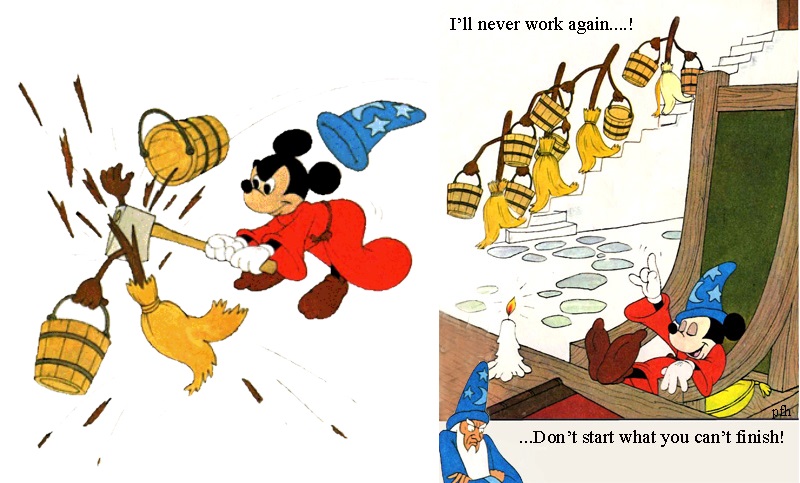
As Mickey sleeps his magic brooms multiply, and his effort to chop them up has the opposite effect, not knowing the magic to make them stop.

The failure of Mickey’s strategy would, of course, be repeated if Sanders’ grand gesture calling for “breaking up the banks” were to actually be applied. The various banks that have now grown overwhelmingly big, magically carrying our water so we can accomplish ever more without work, will all just continue expand, as long as we ask them to use our savings as before. You would just get more banks accumulating more disparity in the wealth of the world. Whether the phrase “break up the banks” refers to dividing up the banks into smaller ones, or separating their savings and investing functions, it wouldn’t alter a bit the basic service they are being asked to provide us as investors. They’d still be using our idle money to multiply, in some magical way, so we can be showered with fruits without labor, and left with the puzzle of why that can’t keep working.

Investors may or may not feel “wet”, but if you look around the world, everyone else does look rather soaked! It’s a quandary that we’ll have to resolve, why the secrets of creating wealth were apparently not shared by our process of enjoying wealth. So what’s clear, at least, is we now have a new job. It’s not one that Wall Street asked for, perhaps, but that they can’t refuse as they work for us. It’s to break with the Faustian bargain we made with ourselves, and perhaps stumbling some also stumble without regrets so much as anticipation, get about the work of showing the world another side of what we can do with our genius.

Here we don’t find ourselves without a plan of action, is what’s different from the many calls to protest, though the plan may need repeated adjustment and improvement in various ways. It’s ironically not like Bernie’s plan to “not take Wall Street’s money” either. It’s indeed to “take Wall Street’s money” we belatedly realize, because Wall Street is in fact just managing our money for us, and we just need to as for the right thing. That’s the real way to break our bargain with the Devil, that we do seem to be at a great historical point of rejecting. We can take our knowledge of wealth with us too, but only if we learn the other tricks needed to leave the earth whole and to share.
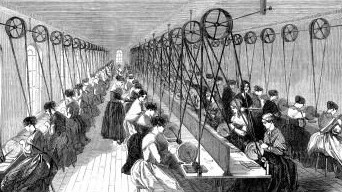
Did Keynes & Boulding both really say that?

  • ed note:   The current discussion of the core dilemma of capitalism, as a limitless system for creating growing wealth, is in terms of the crises we now face caused by it, producing socially disruptive innovation and growing financial inequity.   Those include  1) threats of rapidly growing social inequity, 2) unsustainable national and private debt, 3) disruptive scales of job loss from globalization and automation, 4) demands for unachievable ever faster and ever more complex learning and change , 5) the rapid depletion of earth’s resources, 6) disruption of the climate and earth’s ecologies, and of course 7) increasing international conflicts between conflicting economic interests,  and of course,  8) growing risks of grand scale financial collapses due to failing promises, as a kind of general list.  It’s quite a list.   There’s been a very long debate but mostly scattered in pieces and hidden from view.  That’s both because the primary culprit is our whole way of life, naturally hard to talk about, and what to do with “money” .
  • The design of our economic system that defines “capitalism” is very simple.  It’s “the use of investment profits to build up investments”.  That’s it.   Why such a simple practice has a hold on us is that it promises both society and individuals ever faster growing profits without growing work.   Of course that tends to end up badly, having been much too good to be true from the start.   The equally simple design of all natural systems is that “any system needs to build up to get started, and then stop building up to continue”.  The two definitions conflict.   Keynes and Boulding foresaw that the two would come to blows, once the economic system had built up and needed to stop building up to continue.   They saw capitalism could become like a natural system and can change only if investors spend their profits.  The sense of it is that investors would “pay it forward” so their profits would take care of the future rather that keep “paying it back” so old money could take ever more from the future.  It would let our economic system first build up, and then stop building up, to be able to continue, with no guarantees but as a possible path forward.   It’s all too simple as a design problem, as how all enduring natural systems develop and needs the social principle to make sense.  The dilemma is completely unsolvable as a financial problem within capitalism, though, challenging our  whole way of life as a rather immediate concern.   jlh 3/14/16 

____________

The intensification of work for concentrating wealth and profits.  – Click – to see QuarksDaily article on how this process drains our world.


_____________

from a 21st century view……

Your question is,  do we all use our profits to extract increasing pay back from others,
building up an ever growing drain on what makes our world profitable?
______
Or do we pay our profits forward to assure our world remains healthy
to grow our own ideals, our families, our communities and our world,
treating profits as a gift to what matters?
______________


J.M. Keynes and Ken Boulding were early and mid 20th century “whole system thinkers”.   They were true geniuses, struggling for words to convey how complex systems with all independent parts work as a whole somehow.   It’s truly the profound puzzle of nature, how illogical it is that all the independent parts of systems would act as if they were all coordinated.   They didn’t stop at just looking for simple rules of prediction having no idea where they came from or when they might change.    They also looked for and found elementally simple organizing principles of design, for how the parts of market economies coordinated with each other as whole systems and what drove them, central principles they weren’t able to communicate and that have yet to be appreciated at all.   From their views they did each say that:

the world economy would soon bankrupt itself by over-investment,
as a natural limit to unlimited financial growth,
due to the central driving financial practice of compound investment

Each was also a expansive thinker with their own ways of speaking about broad principles, so they are hard to read too.   It’s only by learning to think about the economy as a whole system, with all its parts working together, and distributing its surpluses and shortages throughout all its connections, that you can piece together from their writings the common finger prints for the above simple principle as what they were clearly saying.

I had some extra help with it, though.   I learned of Keynes’ work on the natural limits of finance from speaking with Ken, having gotten a chance to ask him in person, if he knew of any economists who had studied the limits of compound investment as a natural limit to growth.   I had asked Ken about it in 1983, and was able to understand what he said on the subject, because I had been searching for a few years already for anyone else who had discovered the principle, that growth systems, if not interfered with, would naturally upset their own conditions for growth.   It’s a completely invariant natural principle. Continue reading Did Keynes & Boulding both really say that?

Object Oriented Science, An Emerging Method?


The traditional scientific method doesn’t fit our new information world very well, with the rapid emergence of so many new forms of knowledge communities, computational science and commerce, seeming to take over.  They are also being built on a foundation of science with major problems unsolved,  like an understanding of how complex systems emerge and become unstable.  The Edge asked What Scientific Idea Is Ready For Retirement?, and got 174 responses, one of which was Melanie Swan’s answer: “The Scientific Method”.   She points persuasively to the differences between the emerging computational approaches to knowledge and the traditional practices of science, and hopes a “multiplicity of future science methods can pull us into a new era of enlightenment just as surely as the traditional scientific method pulled us into modernity.”  

There’s a flaw in that, though I generally agree with the hope.  Science is still unable to study nature except in abstraction, representing nature as a theory of deterministic calculations.  It’s been unable to use them to study 1) our own or nature’s great creativity, or 2) any individual thing or event, in its own natural form.  It matters because our old habits of multiplying new forms until they caused trouble is now the foundation on which we’re adding an uncontrolled “Cambrian explosion” of new forms of computational (and often disruptive) knowledge. We also appear to be trusting the future of civilization to them, even as the radiation of old forms further depletes and disrupts the natural world.   It’s seems we’re “missing something”.

So, my counter proposal is to open the eyes of science to the study individual natural systems as subjects, not just as abstractions, but to learn directly from them, to create an “object oriented science”.  My years of work on that, creating a form of physics for studying individual natural systems, works by raising particularly good questions.   For example, all natural systems that develop from a common origin as individuals are found to face a common pattern of life challenges, in part:

“getting started”, “building internal relationships”, “establishing external relationships”, “fitting in” 

There are reasons to worry when the foundation for a radiation of new sciences is an “old science” for radiating new forms that make us quite unable to “fit in” on the earth.   It makes it likely that the new forms of knowledge instead of correcting that, actually contain the same flaw as the old one.   I think a very big part of that comes from science relying on representing nature with equations, that have radically different properties from the subjects that are meant to represent.  


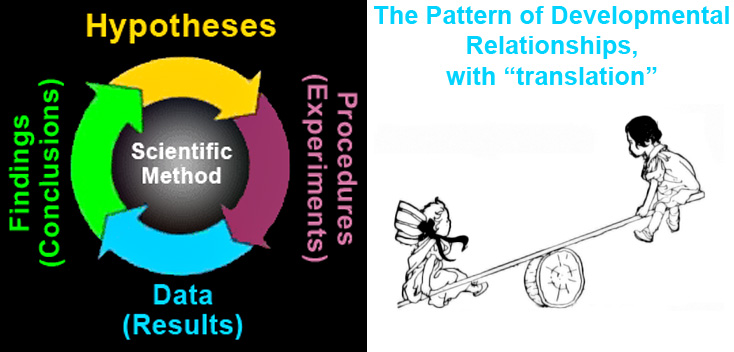
The Scientific Method can be expanded to include a General Study of Patterns of Natural Design. Imagine learning cycles like these with energy added to each step ever faster, by %’s.

A counter proposal…

[first posted to IEET article] Certainly the recent discovery that “the world is complicated” (and both people and nature unusually *inventive*) does expose a deep flaw in the idea that nature follows simple scientific rules and models.  That seemed plausible only because some of the simple rules of physics are also so amazingly reliable.   Those still exist, and others are to be found most likely, but the question is: “What then do we think of them?”

I think we probably should not throw out the scientific method… particularly just because we’ve been misusing it.  The common flaw in our use of science as I see it, and studied since the 1970’s actually, is its “misrepresentation problem”.   The world is not a model, and we’ve been treating it that way.

The world is not made of numbers, not made of quantitative relationships.   It’s made of organizations of separate things, often found in “improper sets” with the parts of one thing also often taking independent part in others too.   It makes things in nature *highly individualistic*, and held together by some kind of “organizational glue” we’ve hardly begun to study.    That presents not only a wonderfully interesting “mismatch in VARIETY”, but also several wonderfully interesting “mismatches in KIND” as well.   It may not be ‘neat’ but it’s very ‘lifelike’, and opens all sorts of new doors!

So what I think we need to retire is not so much “science” as “the representation of scientific models as nature”.  The article points to a number of the big discrepancies that have become too big to ignore, but where does that take us??   One place it takes us back to the age old “million dollar question” of how science is to refer to nature at all.  What is it we CAN define that DOES NOT misrepresent what we are studying??    I think a quite simple place to start (and obvious solution once you recover from the shock, I guess) it to treat models not AS nature, but AS “our limits of measurable uncertainty about nature”.  Yes, Popper and Bohr with turn in their graves… but models understood as representing upper and lower bounds within which we expect nature to operate, independently, will also be found to be much more useful.

If you actually look closely at natural behaviors you readily see that, that the paths nature takes are always individualized, and we can understand them much better having some information from past events to suggest what to expect.   It gives you a straight and clear view of the all-important “discrepancies”.   To make use of relieving science of its century (or more) of seriously false thinking, about nature being theory, what you then need are ways for science to refer to nature as “individual phenomena & organizations” to identify the stuff of nature that science studies.   In our century or more of trusting abstraction by itself, that’s what I think science has been missing, having a natural object of study.

So, in a fairly direct way I’m calling for an “object oriented science” to correspond to the “object oriented programming” that has become such a big help for giving order to computer coding and the web.   My main two tools for that are what I call a “dual paradigm” view (alternating between attention to ‘theory’ and ‘things’), and a “pattern language” view (the emerging scientific method of describing natural organization based on Christopher Alexander’s work).

Alexander’s pattern language is evolving to become a versatile general method for working with ‘recurrent patterns of design’ as ‘whole sets of working relationships’ found in ‘problems’, ‘solutions’ & ‘environments’.   My new work describing how these fit together is being presented at the PURPLSOC and PLoP meetings this year, presents a broad picture of the fundamentals, and very worth using to begin the process of recognizing natural design as a working environment.   If interested, do searchs for “dual paradigm”, “pattern language” & “Christopher Alexander” both on the web and in this journal.


Are we protecting our symbols? or protecting the earth?

Warm greetings, real math.

________________


We publicize the “special places” that are threatened, and people respond, yes.   But we have to face that after 100 years of doing that, the environmental movement that our conservation groups and actions have been at the center of, has protected lots and lots of **special places** but is still not protecting the **ordinary places**.

Protecting thousands of special places, the ordinary places left unprotected

The effect of our organizing has been as if we didn’t know the ordinary places were just as threatened as the special ones, by the same visible and ever expanding encroachment from our economy.  Don’t we need to get that straight?   Don’t we need to be much more direct in saying that the threats to the special places (that get everyone’s attention) also symbolize the threat to the earth as a whole?

Places like Tucson we haven’t protected

If we do that it could materially change the common goal, recognition that really save the earth we need to **remove the threat**, not just **protect the things that symbolize the threat**.   Isn’t that a change in view we need to bring about?

Continue reading Are we protecting our symbols? or protecting the earth?

Simple realty – Income Inequality is caused by environmental drag..

This is as simple a story of this amazing change in our economy.  What happened is that the economy ran into increasing resistance from the environment.   The inequity came from how that slowed down wage growth more than the investment income growth.    Below are two simple ways to understand the natural cause of the problem, that were posted to the discussion on NPR.org today.

A challenge to the new congress: Fix Stagnant Wages

Without a major rethinking of our growth strategy it really can’t be fixed, not by this congress or any other, as it’s “natural”.   The problem is our growth strategy is running into ever increasing natural “drag” and “resistance”, that affects labor more than investment earnings.    


See also my recent articles:
Kepler”     –  a great story of student discovering how to understand the big picture
a Whole Systems view – Piketty’s “r > g” – Relating it to Thomas Piketty’s book on global inequity


  •  Comment 1

You never seem to be allowed to talk with the people who know why wages began stagnating in about 1970. There are very specific natural reasons.

Keynes predicted it. I’ve detailed it to the Nth degree. It’s a perfectly common problem in many ways. The simple word to call it is just “drag”. The economy is meeting ‘drag’.

You experience drag as a kind of resistance to what you were doing before. There are millions of kinds. The evidence of very numerous kinds of resistance increasing at accelerating rates more or less all together at once, for the whole system… goes back about a century.

You should talk to people who know.
http://synapse9.com/signals/20…


  • Comment 2

None of you seem to understand that economies are designed to run themselves. Nobody mentions that in the media either, or even the smart pundits. I guess it’s because the people you hear talking about it are really just competing for attention or promoting their ‘angle’ or don’t know any better.

The real situation is that economic growth is stimulated by the money earned by investors being added to the pool of money for creating more businesses. So with growing investment you get a growing economy,… and it’s markets expand, using more and more of every resource they can find on earth…, till something goes wrong.

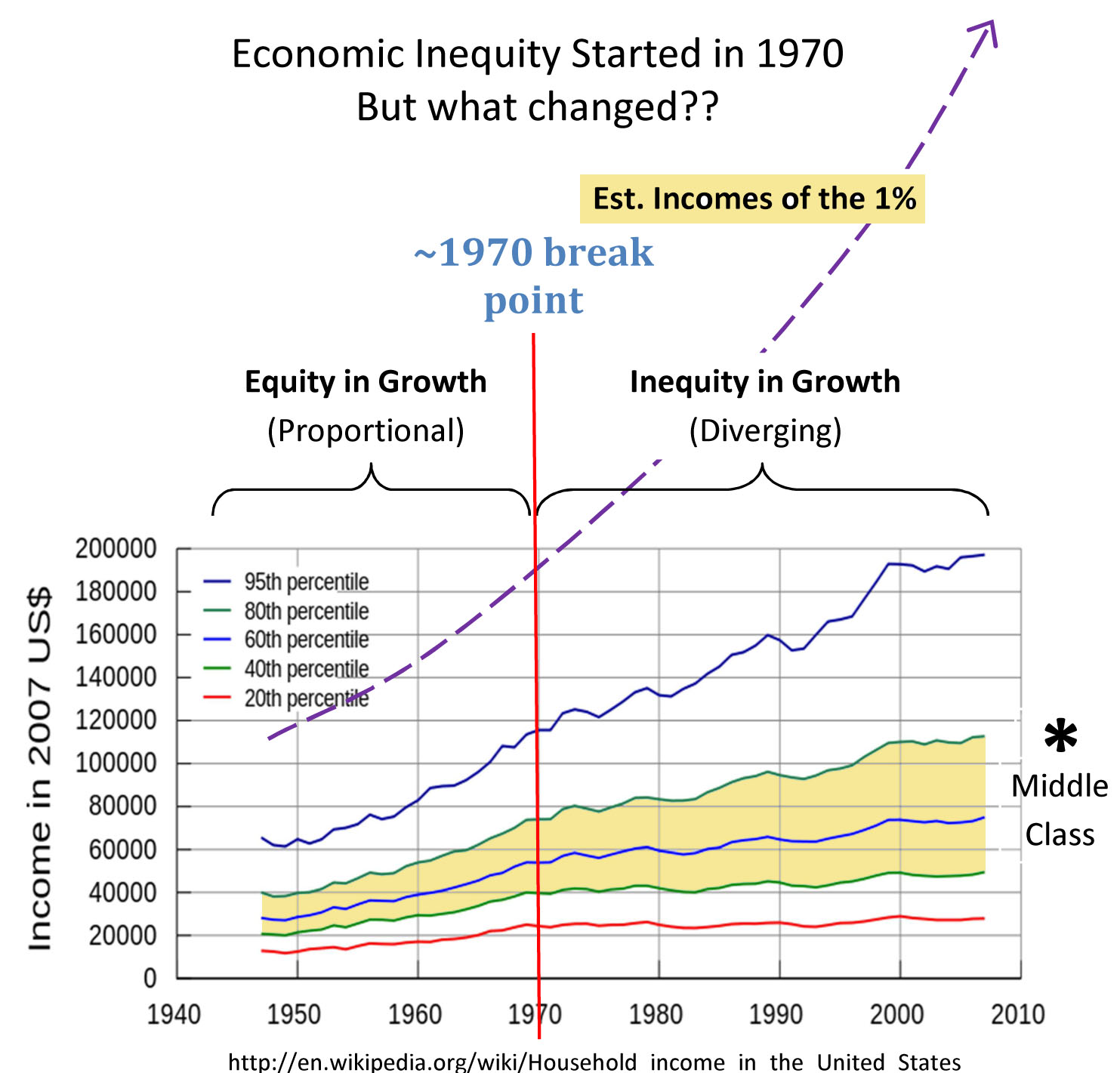
When things are going right, like in growth periods up to 1970, the incomes of the rich grow faster than anyone else’s, *but* there’s enough left over to “trickle down”, so the incomes of everyone else keep growing too, just a little slower than for the rich.   After ~1970 the relative rates started spreading apart further and further, till most people don’t even increase their incomes as fast as inflation…

One of the things going wrong is the economy is running into natural resistance, from its growth having changed the world, to make it less bountiful.   The economy is slowed down by needing to use more costly resources, from increasing complications of regulation, increasingly complex designs and teamworks needed to get anything done, increasing costs of global competition and conflicts between industries demanding growing shares of diminishing resources.

What’s most obvious if you look at the data is that after 1970 growth continued for the richest and not for the rest of the wage scales. I think there were all the above problems creating drag for the whole system, effecting the productive economy and lower incomes the most, and the people at the top the least.  People of course saw that was where to make the money, and those that could went in to investing to use money to may money that grows without actual work.   Investing is a kind of ‘work’ where the more money you have the more you earn, without any actual “labor”.  So, that kind of earning really took over.

There’s lots more interesting to say, looking at the economy as I do as self-guided system driven by people’s choices and the capacities of the earth the find to use and use up that way.   The bottom line, though, is that there’s too much unproductive investment.

The one and only way to reverse that (other than “resetting” the game with gigantic financial collapses) is for the wealthy to *spend* their earnings rather than *accumulate* more unproductive investments. JM Keynes actually proposed that would be necessary, as the solution for this very problem, that he saw as likely to come up in what he saw as the relatively near future, from the 1930’s.

I’ve written lots on it myself, but it’s “unpopular” because you need to look at the financial implications of our having been running into increasingly resistance to growth as approaching limits, for 50+ years….   That subject was made socially “taboo” in discussion groups not unlike this one all over the world in the 70’s, in case you don’t know about that.   And the whole world went to sleep in total denial of there being limits to growth or anything eles, population too.

http://synapse9.com/signals/

 _______________

jlh

How can prosperity be based on “Putting money in to take more out”?

The trick is that there are two ways to do that. 1) you can add the money you earn from investing money, to increase what you then reinvest, so it multiplies what you take out (to put back in to take out more), or 2) you can use the money you earn from investing to take care of the things your investments built, or anything else.

Some links to other discussions of it are below, and a request for your comments.

Here’s an excerpt from a Facebook exchange. It goes another step in explaining why this particular difference, using profits from investments to build more and more to profit from, or to care for things, causes major confusion in our modern world.  We want both, definitely want both!   But they’re mutually exclusive and there’s a kind of “deadline” for making a choice that most people, for some reason, would quite prefer to ignore, as if there was no choice to be made

 ______________
  • Jessie Phyllis Rose Henshaw Speaking of money… Doesn’t “inequity” come from the wealthy PUTTING MONEY IN TO TAKE MORE OUT (and so to then put even more in to take even more out)? It *seems* fair… WHEN IT STIMULATES FASTER GROWTH, but that isn’t determined by people, but nature is it?
  •  Helene Finidori That’s a great statement Jessie. Could we say faster extraction? Also well I guess many want to put some input into something to get a little out (think of mom and pop savings for retirement). The question is to what limit… Could you plug this somewhere on the pattern language site? Because this is typically the ‘more of the same’ that any new solution would like to avoid…
  • Jessie Phyllis Rose Henshaw Yes, I’ll put it there. If I’ve finally said it so people would ask questions, like you just did, then I’ll need help expanding on it so I don’t lose people with the details. The issue is *the balance* between the strains on nature and people and the increasing scale of the whole system.If it were a policy decision, it would be to “stop counting on an ever bigger windfall from the future”. The default way to do that would be to ask everyone to plan for a future of “pay as you go” and people with large investments to use their profits, primarily, to heal the strains on the commons instead of continuing to invest their profits in expanding our burdens on it. Mom & Pop’s savers tend to do that anyway, so no policy required!
__________________
Please add comments on what puzzles you about it, your creative questions or observations. What should we do with our money.   The earth commons we are part of has the profits from a hundred trillion dollars to think about how best to invest, and all the people who expect it to just keep multiplying forever to buy in on the plan too!
If interested in the field of pattern languages, join the discussion of this post on the Pattern Language Site in

Challenging Puzzles and Propositions

“Pattern Languages” give meanings to patterns in nature, theories, relationships or experience, but we often don’t know quite how. Like, we all tend to consider our own conscious view of things to be the world we and everyone else all live in… even though everyone is making up their own view of that. That kind of real world doesn’t fit into any simple explanation, of a world in which everyone is seeing a world that is in large part a reflection of themselves.  It creates a lot to untangle.

Continue reading How can prosperity be based on “Putting money in to take more out”?

‘Big Data’ and the right to human understanding.

One of the fascinating scientific subjects I research is how human understanding comes from narrative. Without getting too technical, narratives about relationships, environments and culture change issues come from people “observing the flows” of the natural processes, the flows by which those changes in our world take place.  The basic starting point, then, is having some way to observe those flows.  No awareness of the flows, *no story*!

This is such an important thing for combating our alienation from the breakdown of traditional cultures, really all around the whole.   It’s quite an unfortunate side effect of the great eruption of wealth in modern times, and the ever more intense global competition fostered by the world economy doing it.   A small part of how it disturbs our ability to tell stories about what’s happening to us in yesterdays post What is a “rights” agenda, with ever increasing inequity?


Mining live stories from big data is way to build human understanding

Use maps of natural silos of conversation to find who you need to talk to and how!

I ran across five wonderful examples this week alone, of ways to bridge the enormous cultural and intellectual divides the keep us from arriving at a common understanding of what to do with the earth.     My topic yesterday saw how an economy structured to produce both ever increasing complexity, inequity results in the breakdown of traditional cultures and ways of knowing, a loss of stories for giving our lives meaning.   Learning to see the problems can also be used to find solutions too, of course, the main one here perhaps just learning to see what we’er doing to ourselves.   The thought process leads to seeing what strategies are failing us is not so different from that used for discovering promising new ones.

One identifies where the cultures that guide us lose track of what’s happening to them.   The other discovers exposes the flows of events in a way allowing us to create the new stories that will matter in our lives.   It’s how all human rights are achieved, by recognizing them as the clear story that beings order to a disruptively changing world, recognizing how nature connects the dots, letting us frame not just “good stories” but also “true stories” about finding a sound new path.

The practicalities of recognizing “what’s really happening” so we can use our values to fashion the stories telling us what to do will mostly not need a lot of big words and shiny promises.   You can do it with “big data”, even if today its main use seems to be for controlling personal data to make growing amounts of money from deny people their individuality.  You can also us it to mine the data world to pick up clear signs of whole new cultures emerging you’d otherwise never be aware of, for example.   Having ways of visualizing the eventfulness of change globally, on many dimensions, would be a very *different* kind of “news feed”, a true globally holistic “news feed”.

Every community could study the eventful flows of changing relationships, personal, cultural, economic, ecological, that matter to it, rather than just listen to media largely composed of chattering entertainers and politicians after money and power.   If a way of mining data for signs of events could show people what’s really happening to their world, and that became the the talk of the community, everyone could participate in shaping the news and the new stories about our human rights tell us to do.   It would give the media a real story to cover too.   The practical job to make that possible, though, is more like science than philosophy.     It’s to learn to recognize that eventful change comes from the emergence of new forms of organization, that generally begin with a viral burst of development, that energize whole systems, altering the balance and roles withing their environments, like organisms that growth from a seed to build new natural capital or flame out.

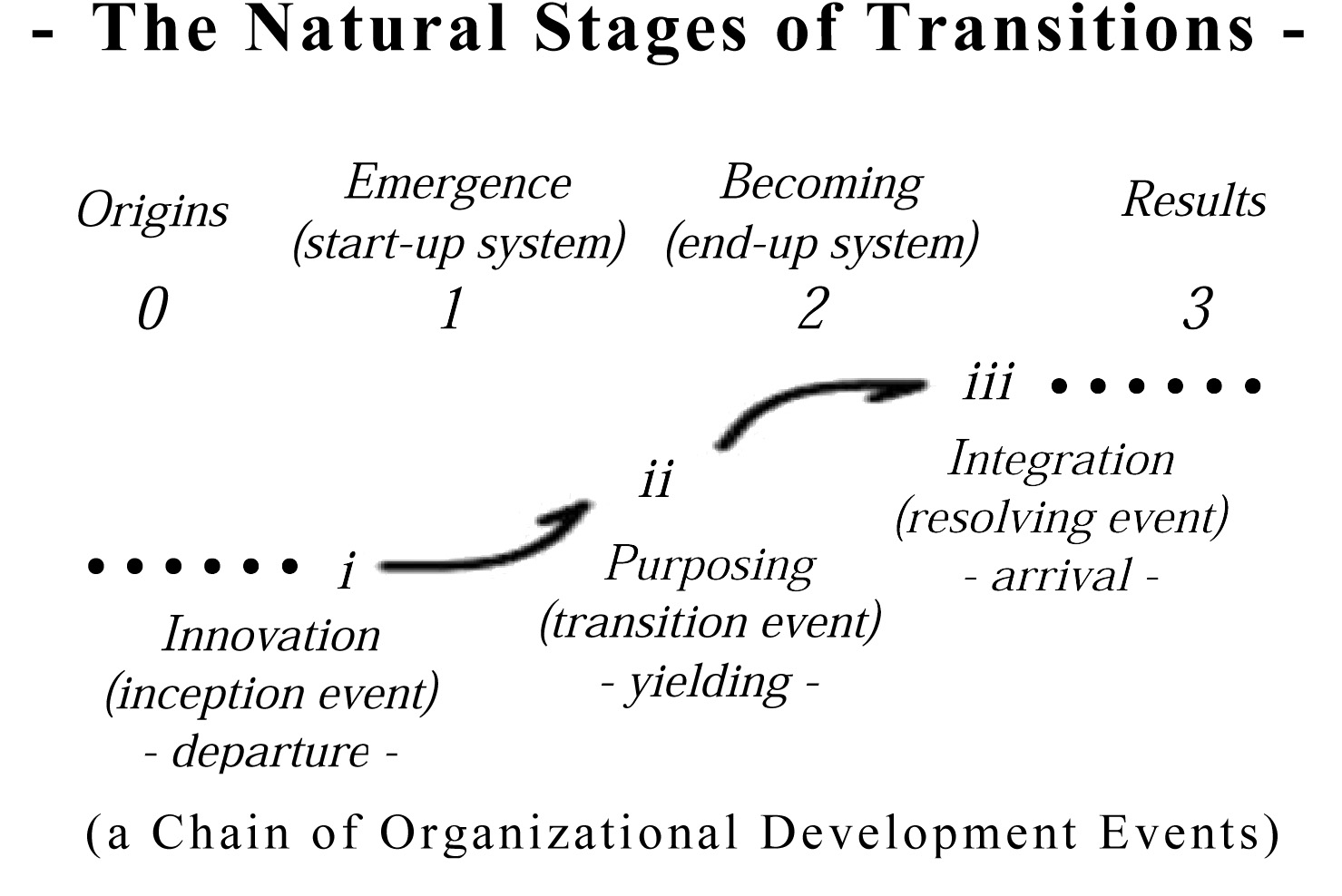
Shown as the general stages of growth for a new form of organization, from novelty to maturity

Examples

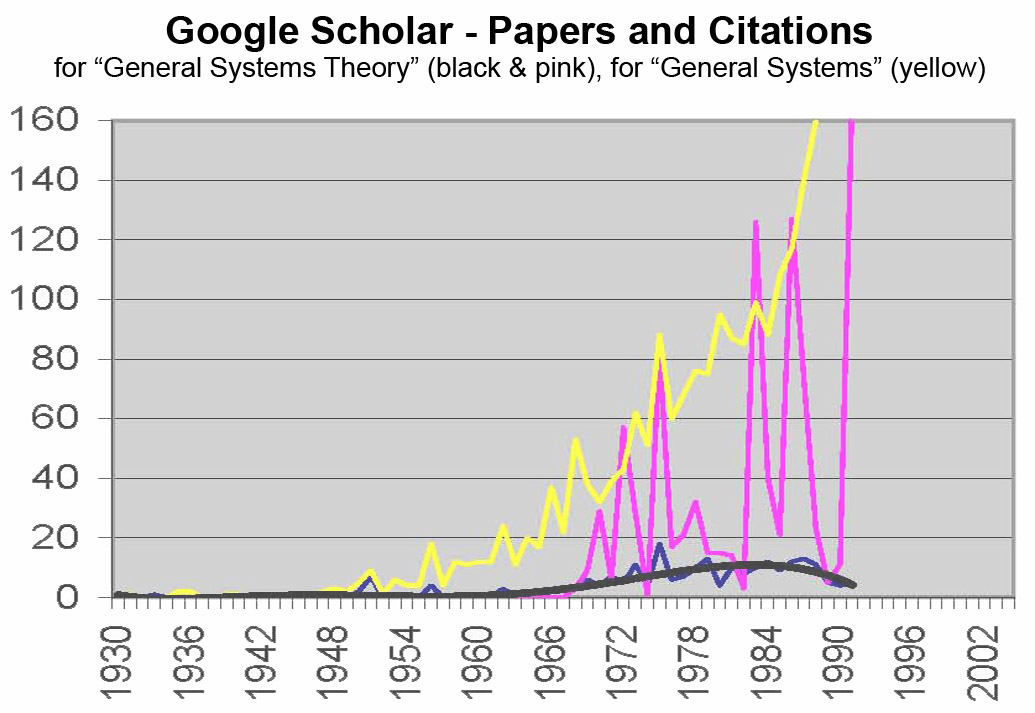
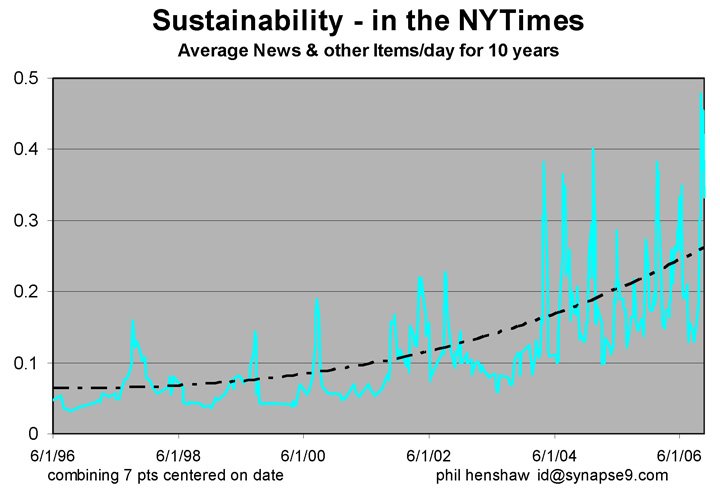
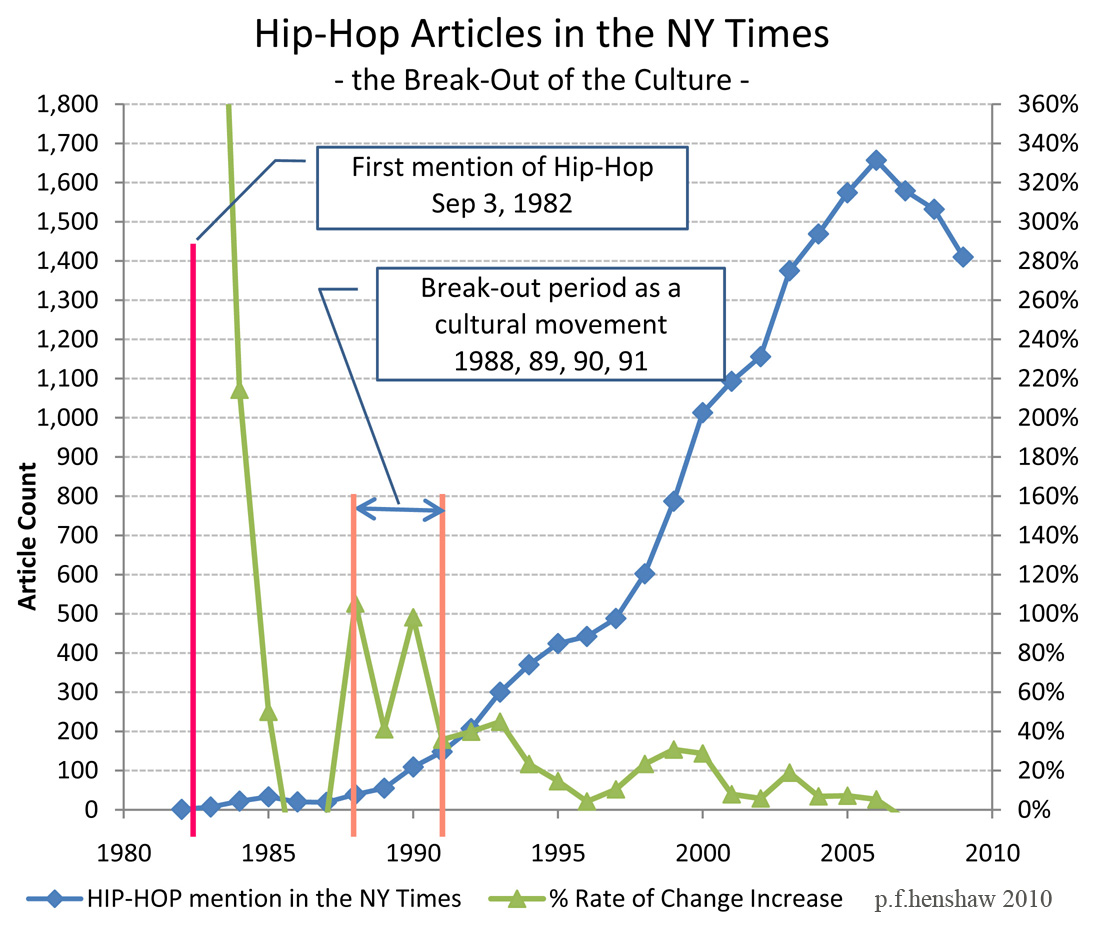
1. –  Changes in Word Use – I am not an expert in semantic analysis, fundamental changes in word use, particularly if following a clear developmental pattern generally do indicate a change in the world of people and their way of speaking about it.    Developmental changes in word usage expose important cultural experiences of the people writing the text.   I’ve used comparisons of the Google histories of word frequencies obtained from scanned libraries of books, their “Ngram” tool. I’ve also used the histories of word use in magazines, newspapers and even Google Scholar, such as to identify

Along with the various other “story mining” methods discussed in the introduction to my scientific method for mining the stories of natural change processes, and method of interpreting them:

Learning to read the eventfulness of our world  –  People who have some personal experience with the environments in which these explosive changes took place, as eruptions of new organization for those worlds,  these documented records of the shapes of their stages of growth provide rich reminders and new challenges to imaging what was really going on to produce the new environments the created.

Papers on “General Systems”(yellow), Papers and Citations for “General Systems Theory” (black & pink)

“Pop Corn” flurries of articles on sustainability as the subject emerged in the NY Times, and Accumulative trend


The 1990 beginning of the big eruption of mentions of Hip-Hop in the NY Times also coincided with the historic sharp decline in NYC crime rates, culture change as kids changed who they looked up to.

Use of “complex” followed  growing economic complexity up to ~1960, when we appear to have either lost interest or the ability to keep up, with the fast increasing complexity of our world.

Today one might also use Twitter and other social media, and also collect data on product and book sales and lots of other sources.   Of course, the sources would vary considerably from country to country, but the method would be the same.   What’s important is for the text or numeric data being scanned for “natural coupling” be “neutral” and not influenced by the subject being explored.

What might be possible, putting it all together, is to identify natural cells of social relationships and their interests, cultural “silos” of relationships identified by their ways of using language, in real time. There are security questions whenever new kinds of information are made available, so such maps should be abstract. The most valuable feature of such a “map” of connections, though, is the ability to then see who’s NOT connecting, the isolated constituencies.

You’d see what conversations are intense in one group and missing from another, say between Twitter and the local newspaper as one possible divide., defining two communities with differing values and interests. That would be a great tool for understanding a society, and a great tool for social activist groups, letting them see how to stop “preaching to the choir”, for one example. It wold also give them insight into the words and interests of the groups they need to connect with, but hadn’t known how. Seen that way it’s a “partnership tool”, allowing people to see through the silo walls just enough to make some connections.

More examples, links, applications & … stories Continue reading ‘Big Data’ and the right to human understanding.

What is a “rights” agenda, with ever increasing inequity?

It helps to look at the long term trends to recognize the long term pattern.

In a world of ever increasing inequities we clearly can’t sustain a real “rights agenda”.    Even the strongest of moral commitments is no match for a world economy which in a lasting physical way, is systematically splitting apart.

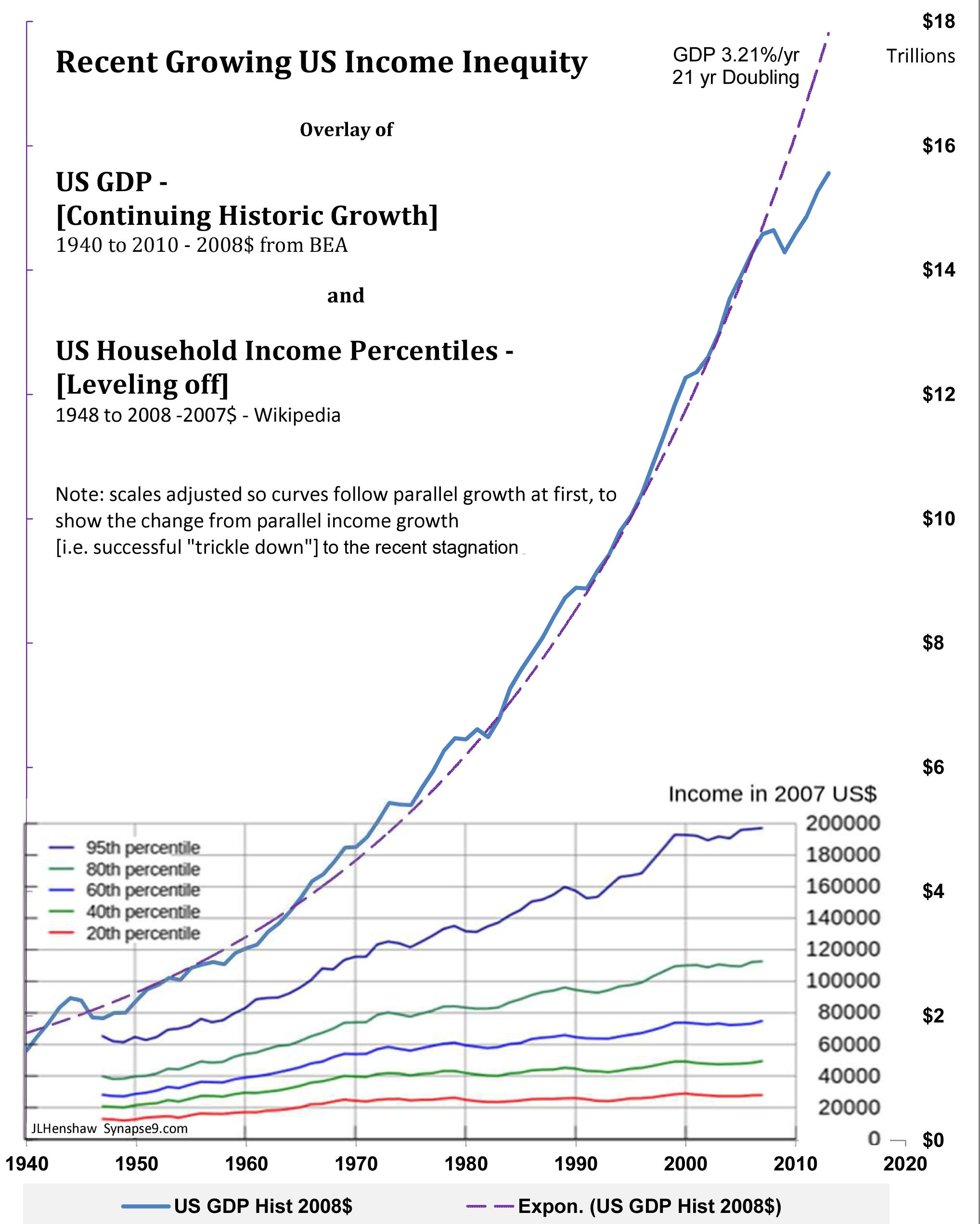
Sometimes local inequities can seem to be blamed on local conditions, but not when it’s a long sustained accelerating global trend.   That’s what we see in this US data from 2008, showing that growing inequity in household income has been a very persistent trend.   It’s a very familiar subject of discussion and increasing complaint too, that ever increasing shares of the wealth are going to the wealthy.  It’s been a central motivation for the UN’s debates on how achieve sustainable development too.   So the trend as of 2008, if anything, has probably only been getting worse.   Little is likely to change, either, with the SDG’s having no language for reversing the pattern of the wealthy being the only winners in the modern economy.

It’s the household incomes of everyone else that stopped growing.

The US Data for a global trend, of rapidly systematically increasing economic inequity.*
*The estimated trend for “the 1%” is based on US and Global data
showing US & Global GDP having continued to grow as before. 


To understand the root cause you need to think about it as a symptom, a symptom of how the global economic system is behaving.   The key piece of information is that “What is happening, is happening for the world economy as a whole”.     Around ~1970 what happened to the US economy, as the bellwether for the world,  is that the wealth of the wealthy kept growing exponentially, more or less just as before.   Nothing else did.

The shape of the Data explains the operation of the system

Continue reading What is a “rights” agenda, with ever increasing inequity?

The option called Circular Jubilee

Most of my economic writing revolves around what we inherited, an economic system design for changing faster and faster, exponentially.   It’s a dangerous design for which we now have no exit plan at all.

Lots of people mistakenly blame the use of fiat currency for the persistent instability and inequity of the economy.   The problem isn’t technically with fiat money at all though… It’s with the deeper compulsion of users of money to use wealth and power as a weapon (we call “investing”), to pay for professional help in taking more wealth and power. It’s the core behavior in question in “the tragedy of the commons” too, that one farmer uses his cattle capital to multiply till the community suffers. Fiat money (basing credit on the value of investments) would actually not be a problem if investors didn’t compound their investments… It’s of course also a broader cultural issue of ignorance about our place in the web of life… but I think the compounding of returns is from what the economy’s growing inequity and disruptions actually originate. I think if investors took care to spend their profits to relieve their demands on the commons when needed then an economic system with fiat money would level out and stabilize.

We need a mid-course correction for the evolution of our economy

What a surprise it will be if to avoid the crises we see coming today, the economy needs a “Circular Jubilee”?  It would be a massive effort to give away a great deal of money, very carefully, with the aim of slowing down the economy’s unstable acceleration.   Done correctly it would relieve the rapidly building strains we all see, letting us escape from racing the economy ever faster till it fails.

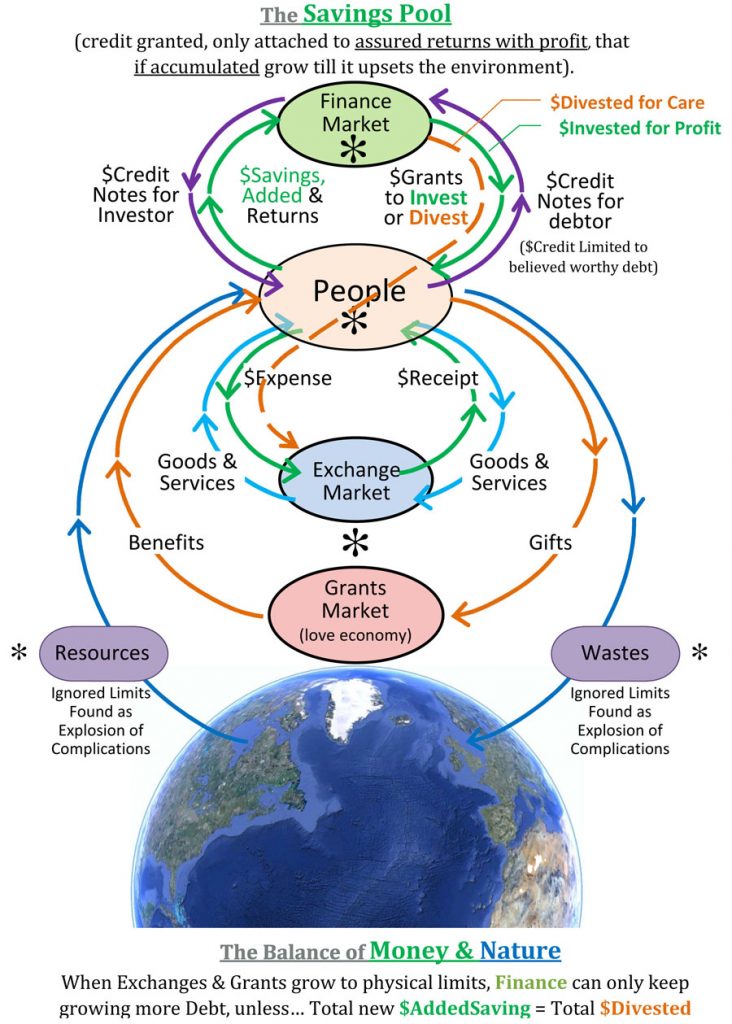
It would be like learning to take our foot off the economic accelerator, to relieve strains and coast a little at the same time.   We really need the relief.    That really does seem necessary to relieve the economy’s building strains in a lasting way.   It would restore society’s resilience and allow us to become more self-healing again too!    The design is fairly simple, …to do just the opposite with financial profits as we do now.   People would be persuaded to join together and turn away from collecting profits to reinvest in collecting more and more profits.   It’s that very widely practiced way of managing money for ever faster growing returns that also sets the course of the economy for changing at exponential rates of acceleration.   It has the globally destabilizing results we now see all around.

That traditional way of managing money we inherited is quite untenable in the long term.  The one truly sustainable alternative is for investors to learn to spend their profits rather than continually reinvest them! It’s simple math.   That’s the the Jubilee part, investors choosing to “release” their profits back to freely circulate in the exchange economy again.  The “circular” part is that those profits then freely circulate in the economy  again, and return to the investors as sustainable profits.   That is the opposite of how we manage our money today.

Today the profits concentrate in the hands of investors at ever faster rates, to only circulate in the economy with promises of being repaid multiplied.   It seems to investors that they are becoming more and more wealthy as their world and all its strains increase faster and faster.   That’s the fatal path, pushing us toward society’s many possible breaking points.    We can do better.


Compounding profits may sound good,
but driving economic change faster and faster
till we are pushed to disruptive and unstable change… is a real problem


((in the diagram, the choice is shown as the alternative between
“$Divested for Care” and “$Invested for Profit”. ))

How the finance economy gives way to the love economy, spending financial profits to earn them back

JLH

(note: first published in 2017 but back dated to 2014, as more consistent with proposals of that time. Using collective profits to care for the commons (rather than for abusing the commons) has been the natural general solution to the tragedy of the commons first recognized by Keynes, and that I’ve proposed in various ways since I first noticed it’s simple necessity around 1979.   For more of my writing on it search for my discussions of Keynes.)

A World View of Off-Shore Energy use

There’s been a long debate and mystery caused by economic accounting for the world’s energy use not being able to trace the trade in economic energy services, the amount of China’s energy embedded in our TV’s and the amount of of France’s energy embedded in Soviet block heavy industry… etc.  

(See also “Pictures of WhatGDPMeasures” with 11 figures and brief explanations tracing the Money/Energy link)

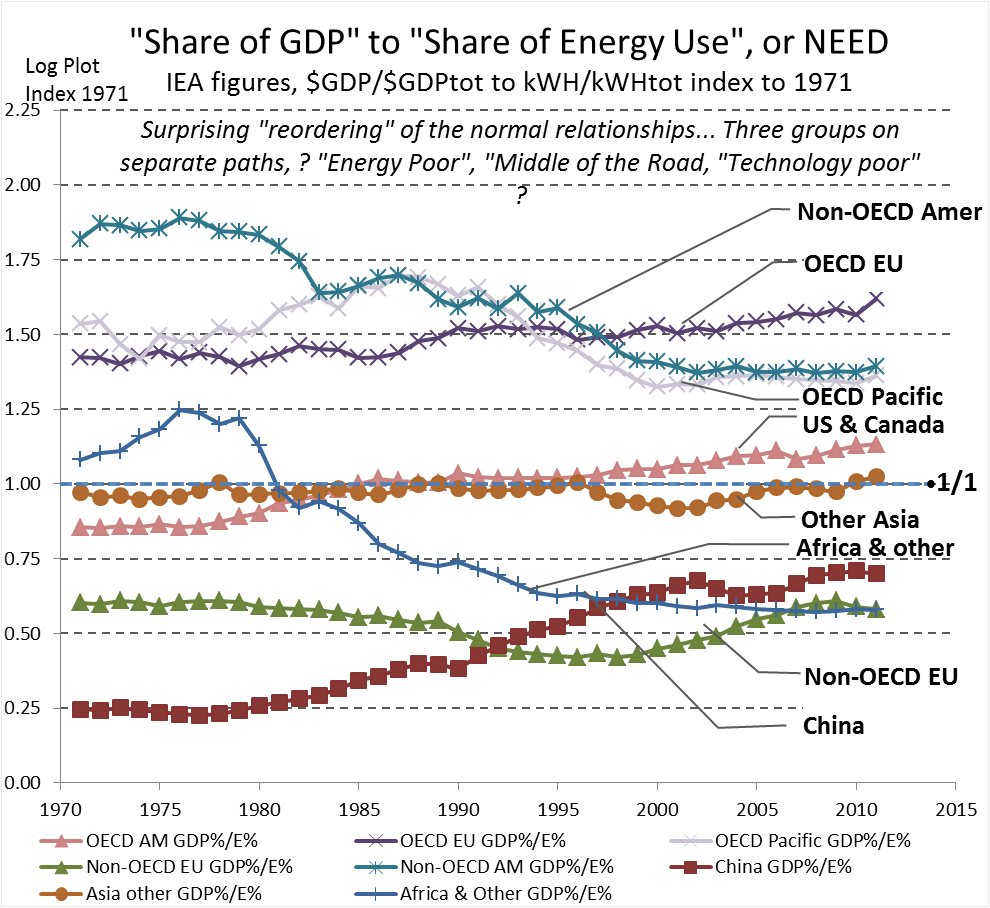
A country’s Share of the World’s GDP per Share of World Energy, measures

“Relative Economic Energy Dependence” ‘NEED’

a strong indicator of how much of its economy is fed by off-shore, mostly ‘fossil’, energy services, most often not being counted in national energy accounts.   Countries do have different energy productivities, but World competition actively selects competitive energy uses wherever they are found.  So like waves on a pond… the national accounts vary in relation to each other, and the global accounts are smooth and reflect the gradual changes of the system as a whole.

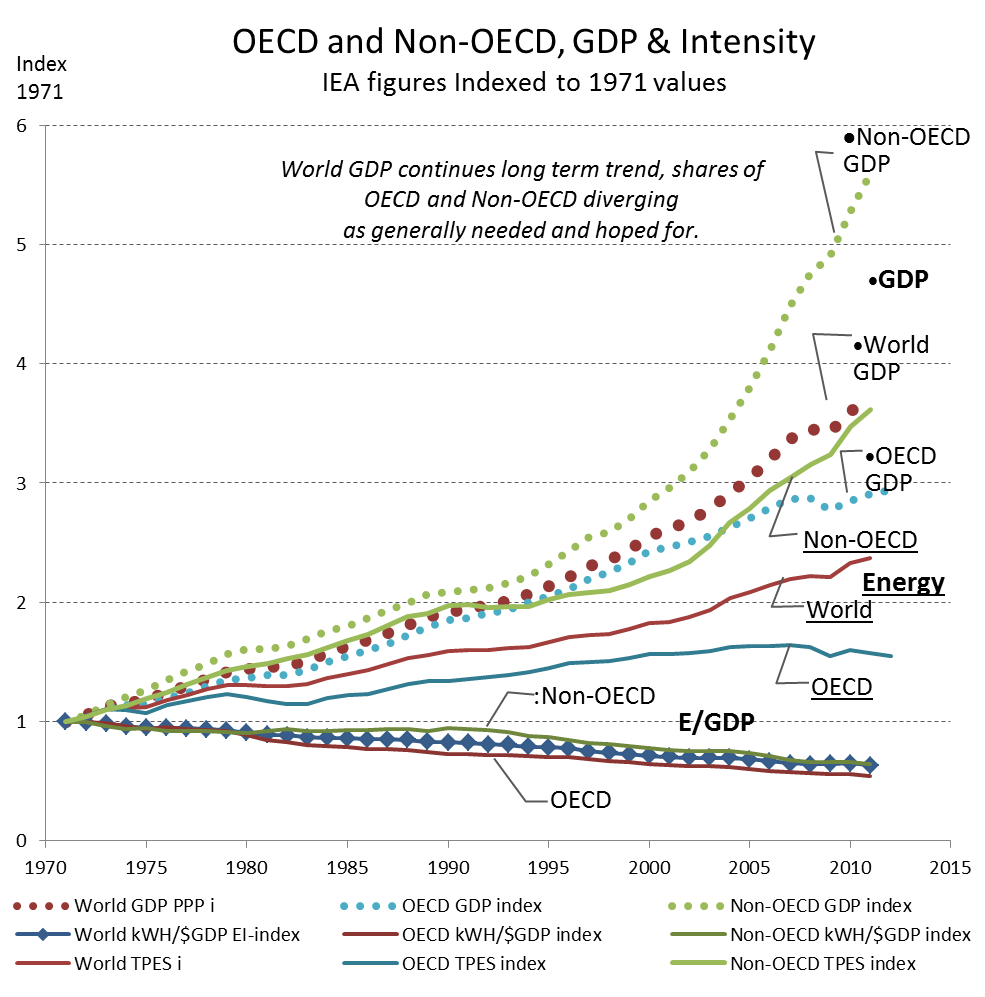
A. – World averages compared to OECD and Non-OECD performance

We see in Figure A strong diverging trends in GDP and Energy use for OECD and Non-OECD groups, along with converging steady trends for the ratio Energy/$GDP, over the past 40 years.

  • As the less developed remain smaller, but grow faster, the more developed are giving them development space.
  • The Energy/$GDP  (intensity) is continuing it’s long historic path of quite steadily decline, NOT diverging, showing how smoothly the interlocked productivities of the world economy “level the playing field” for energy services, delivered to where they are most valued..
B. – The developed countries with less energy supply import energy services from others with more


Figure B shows the NEED of the major 8 World Sectors shows much more variation, and you can see some of he fitting shapes that cause the total to be a straight line.

  • The US & Canada are close to the 1/1 average, but steadily rising
  • The EU, Japan and Australia are ~1.5/1 rather dependent on Off-Shore energy services, lacking abundant sources.
  • So the ridh “Energy Poor” economies need to purchase more and more of their energy in the form of energy services from their neighbors, as “how economies work”.
  • It causes a likely mistaken impression the EU is more “sustainable”, greatly outperforming the US & Canada.
  • National Energy Accounts don’t trace trade in energy services, only trade in energy materials, needing a “Shares of GDP” proxy measure as here to find it.

The National Energy Accounts are not set up to trace trade in energy services, only in materials, requiring a “Shares of GDP” proxy measure to find it.

It shows a very good reason why we all need to learn, as in Scope-4 impact accounting for the World SDG, the use of GDP as a proxy measure of average economic energy use,  and also why it works so well.   The “global economy” and it’s highly competitive use of world information on the most profitable uses of energy.   It makes energy use a universal “currency” naturally, as a useful measure of GDP for many purposes, and the use of GDP as a proxy for energy use and environmental “externalities” resulting from our obtaining and using energy to alter the earth for our purposes.

_______

JLH