That’s an excellent question. What you want is the *accumulative* total effect, for the *choice* being made, not so much the particular carbon sink (if what you want is to give people ways to decide what choices are better than others).
The way you’re starting is just the right way, thinking it through far enough to begin to see the real complications. It is indeed so complicated that leads me to seeing the need for ways to simplify. You want to get the whole picture right, not just use up your energy fully detailing the issues you start with. Continue reading Measuring CO2 lifespan… and signs of nature’s rejection→
There’s another, maybe better, explanation for the conspiracy of blindness to the concert of diminishing resource problems. The lack of a mental model for looking at things as a whole when they have so many seemingly disconnected parts. That’s a real physical barrier to conceptual understanding. That’s also something my method works very well for correcting if you get the feel for it.
I think the best unifying concept to the multiple resource peaks coming at once is that the economic system behaves as a whole, with spare capacity of any part being used to relieve strains on the others, so… all resources then necessarily hit diminishing returns at the same time. Continue reading Highlighting the challenges of 9 billion people→
I think there are so many disconnects between what formulas describe and what they’re used for, once you see it, you’ll wonder why we have not noticed the defect in thinking of ‘everything’ in terms of formulas right from the start. How we’ve made use of formulas has never been to actually follow them.
Their best use is always as learning tools. That’s how we test them too, but then seem to ignore how critically important the learning process is to making them work. Take the problem of sitting at dinner and picking up a glass of water to drink. We have a ‘formula’ for where the glass should be, at the upper right of the place.
It may appear that everything I’ve ever said before was foolish… or at least from a different point of view.
I still perhaps have some leftover habits from when I, like lots of other people, thought that showing other people how they were wrong might interest them in finding if I was right, and then look for a common understanding. I assumed I would someday find people whose sincerity in that way would be unquestionable. I thought I grew up with people like that. Continue reading Now I’ve grown up!→
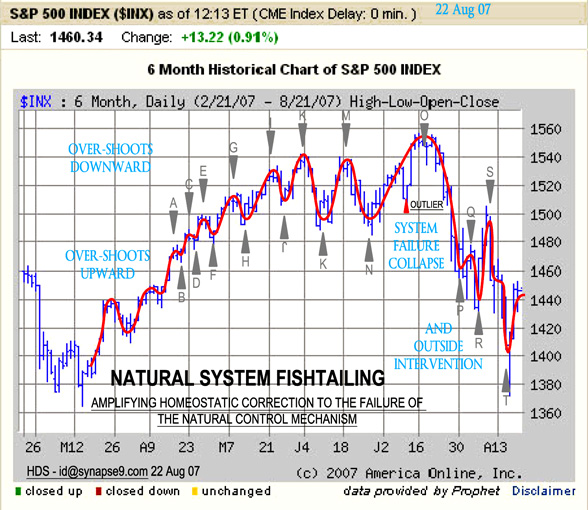
What’s it look like to you? The price swings in the S&P; 500 over the last 4 months seem to display the natural complex system self-controls of the financial system ‘fishtailing.
…this week’s global run on credit seems like a casebook example of how a natural system failure to provide growing physical returns on investment would effect financial commitments for endlessly growing financial returns. They naturally conflict.
One thing we can do is watch it closely, so others may learn from our experience. Because systemic collapse is a big physical process in a big physical system, displaying all-together new kinds of rapidly spreading behaviors, watch for that. If you see that sort of thing perhaps you’ll ‘believe your eyes and ears’ and not feel the observations were ‘planted’ in your imagination somehow.
Remember what things seemed to mean before and after,
and make note of it.
Well, not compounding your returns has the same sort of Catch 22 that doing great sustainable design and having the profits go to pumping up the world’s appetites does. You need to build a broader reason for doing the right thing. For sustainable design we definitely do still need to learn how to live in a sustainable world, even if we don’t have one, and it has to make business sense.
On the first level we just need to respond to the contradictions involved, rather than avoid them. Once there’s a critical mass of people who see that finance has to be different in a sustainable world, then you can think of how it’ll work for the community as a whole. Continue reading Schematic Design of Sustainability→
So I didn’t get takers on the question of what internal limits to growth apply when there are no external limits. It’s sort of a trick question. My approach to the answer has to do with the difference between physical and theoretical systems.
Mostly we think about physical systems as if they behaved like theoretical ones but theories are infinitely malleable and have no inherent limits, internal or external. They’re just projections of rules and natural limits are discoveries of changes in the rules, not extensions. Continue reading The internal limits riddle→
marking a map to help navigating the sysems territory
One of the things that Roger’s comments bring out about the discontinuities you find in tracing organism growth (epigenesis) is the question of markers. Normal single growth curves are famous for representing huge changes and having almost no markers at all to signify what’s really happening.
There really are only two places on them that are easy to mark, the upward and downward inflection points (¸¸ .·|´ ¯ and ¯`|·. ¸¸ respectively). The origins and endings of the curves seem completely disguised by the smallness of events at their tails.
Elsewhere in the history of their changes the wide distribution of seemingly unconnected but well orchestrated events makes it very hard to single out any particular thing for significance. The inflection points, however, can be made quite mathematically precise, and do approximately correspond to matching major changes in what’s going on. Continue reading Quite easy to mark→
Anyone who has changed jobs and had to move investment accounts is familiar with the temptation to buy funds that are high, and just about to fall, and get rid of ones that are low, and just about to rise. Emotional first impressions are generally not a good guide for complex systems, and can cause us to make consistently bad choices.
We have problems of this kind in the design of the sustainability movement I think. Conservation is good, living simply is good, inventing cool things and making room for others is good, and doing these so our world can continually increase its consumption by steady small percents is a total disaster.