
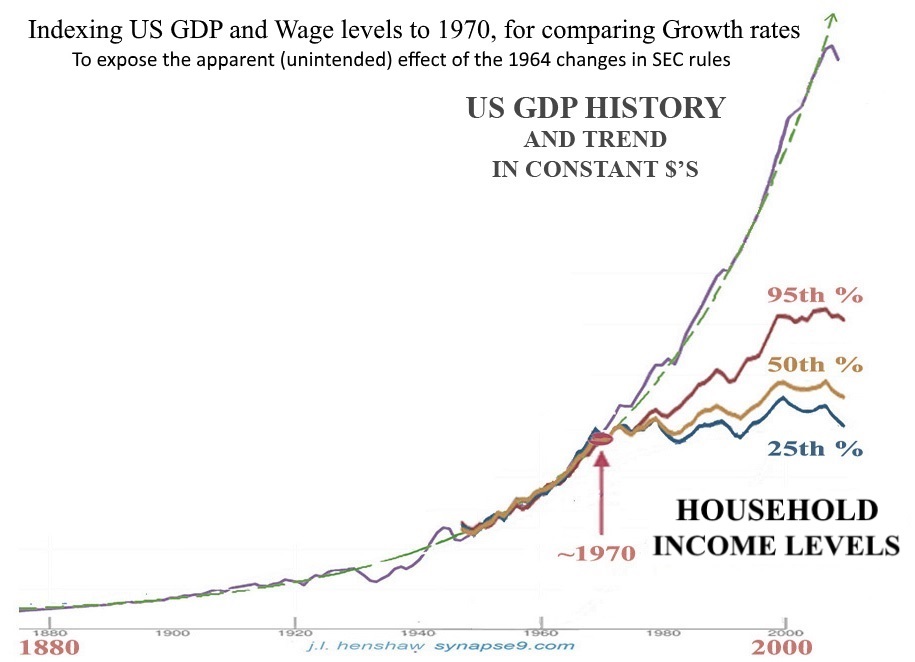
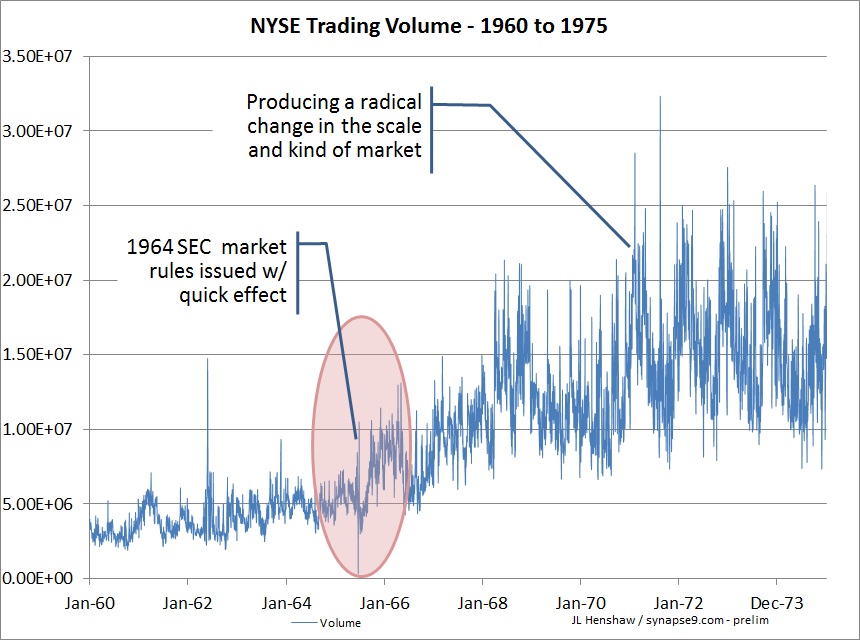
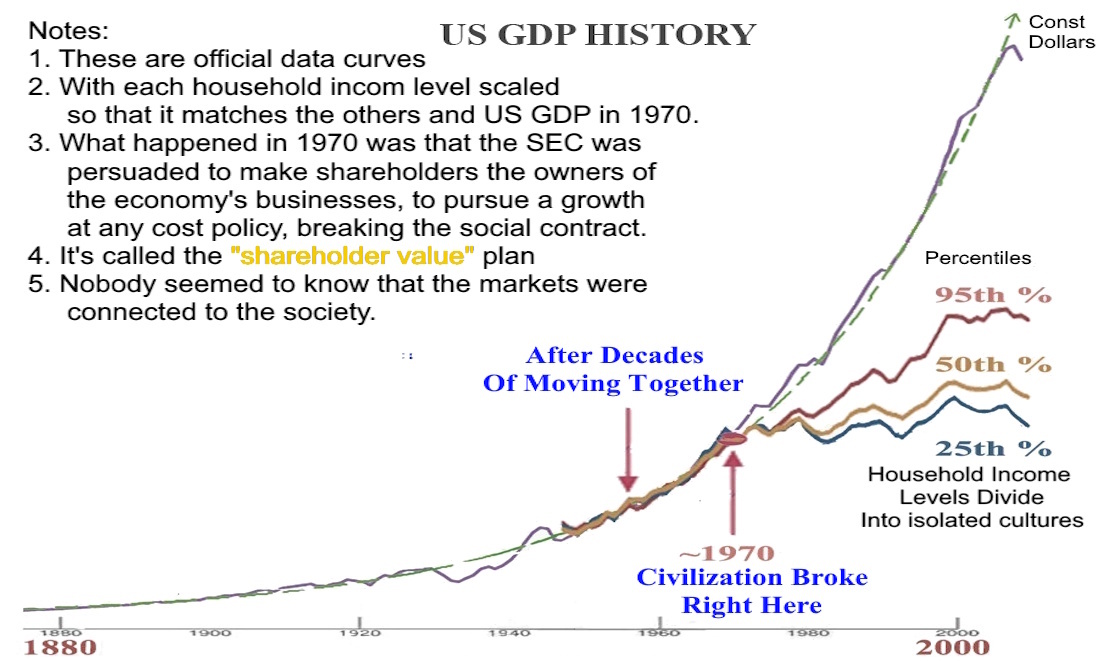
Preface: The 1964 SEC rules change seems clearly connected, but what really happened to so dramatically change the whole economy at the end of the 60s?? Figure 1 below shows that something DID abruptly change the whole future of the US economy, in about 1970, causing a permanent great acceleration in societal inequality. Figure 2 below also clearly shows that the pattern of trading on the US stock market began to radically change in 1965, too. There’s also other evidence mentioned below on what happened. The Marketplace.org radio program 6/14/06 gave another part of the story for the evident sudden change in the relationship between Wall Street and Main Street. They said it was what Milton Friedman wrote in the NY Times in 1970:
- The big change began with a professor. At the University of Chicago, economist Milton Friedman (who would later win the Nobel Prize) wrote this in the New York Times Magazine in 1970:
- “There is one and only one social responsibility of business — to use its resources and engage in activities designed to increase its profits.” [and as it worked out, destabilize civilization in the process]
The coincidental magazine article almost fits the data…, but when did a single comment by an economist suddenly change the world? Never, of course. I think it had to have been deep changes in the rules of business, perhaps then formalized by the SEC, such as with its rule change of 1964. The suddenness of the break in 1970 indicates that considerable pent-up pressure was released all at once. The smoking gun is that the bottom 95% of household income levels suddenly went from growing together with the whole economy to splitting apart.
The result is a rather sudden reprogramming of the entire relationship between business and society, though. We were computerizing and trying to streamline everything, standardizing new business and stock market accounting methods, etc., so that would have to be how it all got connected, and went miles beyond what most people would have ever imagined; giving the ownership of business and all the money to a community that was only playing games of multiplying propfit with no other interest in heart.
The “bottom line” somehow merged with maximizing “shareholder value” for people whose interests seemed to be totally unconnected with real-life values of any kind, only percentages. Those changes would seem to have served anyone being paid in proportion to profits, shareholders, stock traders, executives… and to disadvantage everyone else. [1/1/2018, ed 2025]
_______
For those less familiar with my work, I study an evolutionary development form of physics, using explanatory principles to ask leading questions about how complex systems rapidly reorganize and change form, perhaps the most wonderful, frightening, and inexplicable thing nature does. The clue is that such changes are generally associated with rapidly expanding organizational designs during growth. Other scientific methods treat the shapes of these “curves of emergence” only as changes in numerical scale, thereby totally misrepresenting what is really happening, all by itself. Much can’t be explained, but what can be firmly predicted is that any growth process produces a crescendo of change, one that will upset its own process of change, forcing the system doing it and its design to change form. We should all learn to study that transition.
Earlier writing on it is below, leading up to the one thing to take a close look at, the details of how Shareholder Value apparently caused American civilization to splinter, becoming more and more oppressive to the makers of the economy.
_______
2016 forward:
In the figure below, the economy as a whole is shown continuing to grow as before, while the various levels of household income suddenly split apart.
Whatever the change, it would clearly be catastrophic for the resilience of wage-earning communities. The question remains: What kind of cultural change is exhibited in the data? Was it, as I’ve suggested, made possible and facilitated by the comprehensive SEC and Congressional revision of the stock exchange rules in 1964? Outwardly, the SEC’s purpose was to bring the markets into the modern world, to make it more convenient, secure, and efficient for ordinary people to invest and make money from a growing economy. The exact opposite happened, though.
How systems can change behavior rather suddenly, as we all know from personal relationships. There are always hidden variables and surprising effects from new connections, like building a bridge. Perhaps nothing much happens, or everything changes suddenly. Many other things were happening in the context as well, as seen in the real-time trading data (2), which showed a sudden change right after the rule change. and then took off in other directions as quite new behaviors in the NY Stock market were experimented with. There was an immediate wave of high-volume trading, unlike anything in the past, seemingly ushering in a culture of fast and high-volume trading as a new way of “playing the markets” that may have been intended, or may have been a big surprise, but certainly changed the world as a whole since.
It notably also included a redefining business value for the sake of the markets, as a single number, “the bottom line”, introducing the widespread use of the term to represent a new way of market-savvy for abstract valuations, ensuring trades would be made based more on market psychology than on the organizational value of and service to its contexts of what is being bought and sold, that appears to have been what produced the prior period of stable valuations of business relationships and communities.
If you consider how it might affect businesses, being graded every month as succeeding or failing, and having to constantly raise their finances against the “making the grade” set by market anticipation of business value, it’s clear what a terrifying force it might become. That one little side-effect of the new rules might be 90% of the reason the markets causes all sectors of society to split apart and, led by very sloppy thinking about value and severly opressing the working word doing the rearl design and assembly of what the markes keep bouncing all around, this way and that, always pumping things up to be the firts things dumped the next season. It’s sure no way to run a family, and a family is what an economy physically is and behaves like it up to the year of 1970 when it splintered into bought and sold parts with no inherent value. CEOs and boardrooms across America would be compelled to make decisions that align with market expectations, regardless of the impact on their communities.
It seems some center of business thinking was discovering how much profit could be squeezed out of the economy if business was managed by computer for that purpose, you know, just thoughtlessly driven to maximize some equation, whatever it did or didn’t mean. Was that what created the pent-up pressure that the new rules for rapid trading allowed, as soon as it became possible? It would change business and investor decision-making, no longer managing the development of their cultures, just squeezing them harder and harder, much like school teachers forced to “teach to the test.”
As we know that drugs can raise performance till workers and families break down too, which investors would be unaware of. Teaching to the test simply hollows out the student’s education, doesn’t allow their interests in the world to be their guide. Driving American businesses to meet the numbers, to please Wall Street, would have the very same corrosive effect and be very costly. Driving stock price increases with continual forced “efficiency” and “productivity” gains naturally drains a system’s resilience, too, a kind of enslavement, and very real cause for resentment, and crumbling relationships that may be invisible till too late.
_________________
The first versions of this study, in 2010:
My first notes on the subject date back to 2010. You can find lots of examples of complexity itself being a natural limit to growth, and I initially associated this change in how the economy worked with the rapidly emerging complexities of life. We all experience life as a growing struggle, an escalating “rat race” of new complications, and a constant search for simpler answers. Clear evidence is found in the sudden rise in use of the phrase “information overload”, from the late 60’s on. At the same time, there has been a slowing use of the word “complex”, which I think indicates the complexity of things stopped being of as much interest. Those issues are discussed in: Complexity too great to follow what’s happening… ??
Then in 2012 I realized 1970 was also when computers started being used to manage business complexity, as the first “killer app” of computing really. The global effects would include giving business management a growing information advantage over others, telling them what can be cut and remain profitable, and making business financial analysis based purely on numbers rather than judgement, and somewhat incontestable, as discussed in: Computers taking over our jobs and our pay?
These preliminary studies still seem valid, but fairly incomplete. They didn’t really explain why the change occurred in 1970, or why so sharply. That is what the SEC rules change of 1964 now helps to provide. It appears that the implied “fitness function” of business was redefined to advantage the stock markets and executives, and hollow out the economy for everyone else, in effect violating all of Isaac Asimov’s laws of robotics, as the first big thing we thought of doing with automation.
_______________
The Rules That Wrecked the Economy
It takes a little time to explain the evidence, here showing the long record of US GDP growing by leaps and bounds for 120 years. Overlaid are Household income levels, scaled to equal GDP in 1970, so their proportional changes are displayed. Household incomes are seen moving all together, all changing in proportion to GDP…. from the 1940’s to 1970, but then start to dramatically fall behind. It shows the economy completely stopped “lifting all boats” in 1970, completely disproving the endlessly promoted business lobby idea that how to cure for the “malaise” was to give the rich more (nearly all) of the money.
Households suffered from having to manage the ever-faster-growing complexity of life, but without the growing resources or time to figure it out. It might not have been intentional, maybe just blind, but these trends do seem to literally display 40 years of US households being increasingly devalued, cheated out of the economic value they created, even as investors were cheated too, by businesses being driven to develop unsustainably, only becoming a great public issue now.
The next figure shows the behavior of the stock market at the time when the SEC rules bringing “efficiency” to fast trading and market manipulation by traders, a 14-year record of NYSE trading frequency beginning in 1960. You can clearly see how the strongly patterned trading followed immediately after the rules were implemented, marking a dramatic change from the previous, sleepy manner of trading. You might also be curious about the 40 year record, from 1960 to 2000.
When you see a genuine behavior change like how the trading volume suggests a “sleepy” market from 1960 to 1965 followed by a market of manic movements thereafter, it means people have really changed what they’re doing. I’m not completely sure how well my hypotheses about that behavior change will hold up, what it was and what effect it had. I have a rather good record on a number of other things, though, so I think they’re at least rather close.
I would love to have help exploring more deeply how the culture change involved took place. The SEC’s annual report mentions a number of meetings that may have been involved, and obtaining those notes could be very valuable. The documents I found most useful so far are a 30 pg excerpt from the SEC Annual Report of 1964 and a NY Times article reporting demand for “the bottom line.” The latter interestingly reports on the woes of bankers, as if not sure of how businesses define their values, as an argument for reducing the value of businesses to a single number in a quarterly report. I think that way of redefining the value of businesses shows a clear “spin” favoring the fast-trading culture that is about to emerge. It quite neglected the possible effect on the lasting values of businesses, and the devaluation of the people doing the work, which Wall Street thinking seems to have resulted in.
__________
Work to be done includes
- updating the data from original sources
- more detailed study of the 1964 SEC rules and their adoption, amendments, and “side agreements”.
- studying why the rules were a pivotal “breaking point” for a rapid large scale culture change in how American businesses are managed and how the new style trading cause business practice to change
No doubt, there would be grand-scale malfeasance discovered, and perhaps prosecutable criminality as well. As what happened is really culture-wide, I think finding criminality would depend on when the original meaning of “fiduciary duty” was lost, which would be the basis of requiring financial managers to act in the interest of the people they make decisions for. The main crime seems to be a self-destructive culture change, causing the markets to lose all sense of proportion, and the working classes being disenfranchised. Well, we thought we could get used to it, and now it seems we can’t.
The ideal policy would be to guide people to understanding their own errors and learn how to follow a new path. New York City, like all the “money centers”, is directly implicated in needing to find a new way to make money, for example. For 50 years, money centers have depended on maximizing the extraction of wealth, not securing the future of wealth, and so have relied on promoting disruptive innovations with no heed to what was disrupted… No fury seems adequate to express the stupidity of that. What it does indeed come down to is finding that those money centers will shortly “be out of a job” unless they become as creative at helping to put the world back together as they were at ripping it apart.
Added work to do includes:
- further studying the very special problems of societal manias…. as that is what we see here. What sort of “policy” can one have for societies taking the wrong path, having wandered SO far from creating a world to live in that can last.
If you think of money as physical energy, money being what we use to release our use of it, you can think of the global economy as a rocket ship. The problem, of course, is that our culture has settled on operating civilization in a way that resembles a rocket ship, programmed to accelerate and never land. Our main societal “business plan” is to multiply our energy use, investing to accelerate our fuel consumption as fast as humanly possible, forever. Of course, to achieve that, some money and energy are reserved for keeping people somewhat happy, but if the policy is aimed at maximizing growth rates, every other purpose is at least secondary, if not altogether irrelevant to decision-makers, the heart of the crisis.
So here’s the question: how do we change course when changing course is nowhere in the plan? Do we shove the drivers out of the vehicle? Do we hope to explain to them the use of the gas peddle, steering, and brakes? There may be equivalents in the rocket ship already, but the driver seems utterly unaware of these concepts. It’s a lot to explain, and a lot to learn,
- collecting our understanding of real scope of the problem
The ancient legal principle of “fiduciary duty” is a fundamental principle of professional practice, requiring professionals to act in the best interests of those they serve, and is another example of selective redefinition for managing money. There is probably a clear history of successive misleading revisions, with a legal paper trail to follow on how it came to be turned on its head to serve mainly the self-interests of traders, who were paid for their extraction of short-term profits, rather than serving the interests of the people whose money they traded. I appears that legal opinion now holds it to actually be prohibited for traders to consider anything other than short-term financial returns as the interests of investors, even though no one is served by that except traders and CEO’s who are paid in % of short-term earnings. That is the complete opposite of the original intent, of course. So the redefinition of “fiduciary” seems to have come from cultural blinders like those that produced the SEC rules of 1964, too.
Another, even clearer example I’ve noticed, I also spent a lot of time thoroughly documenting. It’s how all manner of scientific principles are being willfully ignored in managing the world survival project called “sustainability”.
One certainly can’t fault anyone stumbling through this confusing time, making sincere efforts to learn about how our very complex world can come to work again. We’re in a period of unprecedented permanent change in who we are, not planned by anyone, it seems. That said, there are also large systematic errors one can find in the efforts people are making, related to the persistent distorting influence of money. We should have noticed long ago that it was an abstraction stripped of all context.
One very consequential case is in efforts to reduce environmental impacts that businesses are responsible for, using widely circulated, very unscientific rules for counting them. The standard for environmental accounting instructs people to measure the global impacts of their use of the economy by what they record locally. What is shocking is how that “slipped by” so many world institutions and professional communities.
People seem to be just told to never count the impacts of using money, even though that’s the main thing causing all our global impacts. If you’re not allowed to count the impacts of money, it limits your view to your local boundary of observations. So, sustainable cities don’t count the resources consumed from outside the city! Isn’t that so strange??
The same applies to national measures of sustainability, outside its national borders. I’ve been publishing and writing extensively on this topic, and tying it all together in my UN proposal for a scientific method to steer world sustainable development, a World SDG. It starts out very simple, learning to do the math right first, and leading to giving people a full understanding of what our money pays for.
I’ve also studied fairly deeply how all these confusions could arise. Is there something wrong with our minds if our effort to hold onto reality is so fraught with difficulty? What would allow the meanings of important words to unexpectedly change, largely unnoticed? The line between words that are and are not prone to radical change lies between the words we derive from experience, such as those defined by things we can point to, and those we receive from other people based on abstractions, wholly detached from nature.
Most old words directly refer to natural patterns of life and our own experience of them. That way, we cannot lose their root meanings as new variations on their added meanings accumulate over time. The problem is with words defined conceptually, social agreements, and things like the economy that we can’t really observe, and so only understand abstractly. Being unable to distinguish between terms of conceptual thinking and terms for natural experience seems to be the problem. We seem to trust whatever usage of any kind is current in our personal circles. So going between money worlds, or personal, social, professional, or religious communities. too, the same words may suddenly change meaning to conform with that circle’s conversation. That’s socially important at times, but is that EVER a confusing way to think about a world spinning out of control! People may create new abstract meanings for convenience that can then drift widely from one group to the next, meaning different things at every stop, the variation and disconnection to never be noticed.
That inability to distinguish between natural and conceptual meanings seems to spill over as part of all our problems. We rely on natural and scientific language for grounding our ideas of patterns in nature, but we’re at risk if we can’t check such wandering meanings with their natural roots. At present, though, the scientific meanings of natural designs and the natural meaning of scientific ones is only appreciated by a few and are rarely being taught, in much the way those presently disconnected subjects and discussed only in disconnected places, our scientific thinking limited to the classroom, lab, or office, and the meaning of our integrated life experiuences at home or with friends.
Maybe we’d learn more if we made jokes about how impossible it is to frame each in the terms of the other. Then we might learn to see what’s really being distorted.
That’s more or less what I’ve done, collected some things I see how to tie back to nature any time I like, to double check, and help show where work is needed to get the story straight! ;-)
__________
(draft in progress)
JLH